
I‘ve been a bit preoccupied by Life this past week, and I’m really doing my best to churn out some writing, but it’s been a challenge. In the midst of some family matters, some external concerns, and some priorities being shuffled around, I have to say that focusing on output has not been an easy task. Nor has navigating this absolutely bullshit blog site known as WordPress.
CANNOT REMOVE THIS SPACE OR FORMATTING
I was also thinking about how much my online presence as a writer has suffered thanks to the swift shutdown of a European arts database / website I contributed to about a dozen years ago.
A very unprepared jaunt to Berlin in 2012 found me scrambling for work, despite being armed with a visa, but I could always find people to collaborate with, and projects I could throw myself into. One of these projects was being the Berlin correspondent and exhibition-reviewer for what was then known as the Kuntspedia Foundation, later changed to Artwis, and which eventually imploded altogether thanks to what I understood was ongoing and relentless hacking. It hurt everybody who had contributed their time and words and passion to the site, not the least of whom was my editor, a wonderful Dutch man named Boudewijn who was an enormous fan of my art reviews. I’ve checked the Wayback Machine to see if any of my old writings for the site still exist online, and unfortunately, everything has evaporated.
I was very proud of the work I did for Kuntspedia, but them’s the breaks. Nothing was quite as satisfying as having a press pass (I still have it!) with free admission to these exhibitions throughout Berlin for nearly one year. And if I may be so bold, I think the best person to write about art is someone who has no art background; I went into each museum without pretense, training, or expectation.
Thankfully, I wrote everything on Google Docs–as I do with all of my stuff–so I’ve at least kept the original pieces as they were originally composed for the site. I want to share one of them with you, particularly since I’ve been thinking quite a bit about the mortality of those I love dearly. I have kept the entire draft intact. Until then…
Death Preparations
March 7 2012
Prior to my departure for Berlin, a good friend asked me if I had prepared a will, or at the very least, some kind of official document detailing my “death instructions” if something dreadful were to happen to me. This question startled me initially for two reasons: one, because I have absolutely no assets, savings, or valuables to bequeath to anyone, with perhaps the exception of my prized collection of books (a cumbersome treasure, but the one I value above everything else I own, and which is currently stashed back in Canada). The second reason is because the question–the concept, actually–took me aback me with what I felt was a rather macabre topic to be exploring.
My surprise faded within mere minutes of his inquiry, and I realized that it was actually a valid, if not extremely wise question to ask one’s self: what do I want to have happen to my body if, or even when, I die?
There are a few things which are inevitable in life, all of which we cannot seem to adapt to, accept, or acknowledge: change, the aging process, taxes (at least, according to Benjamin Franklin’s famous quote), and death. The latter element, in particular, is a topic that most people avoid in everyday conversation, much less try to think much about in regards to themselves and their loved ones; it is considered taboo, and those who approach the subject in the company of others are likely dismissed as “morbid” and “depressing” by those on the receiving end of such a conversation starter. (In fact, as I was writing this introduction–in my favourite Berlin cafe–I couldn’t help but ask a young woman nearby about this topic, giving her an advance disclaimer that I was a writer and exploring this for an article. Her reaction to my question–”Do you think much about your own death?”–was, predictably, met with a fairly alarmed and worried reaction. “No, and especially not now, as I’m sitting here at a cafe trying to have a nice time,” she stammered to me by way of response. I tried to frame this in a different context so she would relax a bit more, and her reply was, eventually, “I’m too young, I’m 25. Maybe when I’m 80 I will think about these things.”)
Why is this so? What is it, exactly, that causes us such great discomfort at the idea of even thinking about death, much less our own? What is so macabre, so moribund, about having explicit burial instructions at the ready in case tragedy befalls and your life is, in fact, taken from you long before you were prepared for it, or expected it?
It is the exploration of this topic, and the occasional musings I have had about it, that triggered my interest in attending the exhibition at the Neues Museum entitled “Of Final Things: Death and Burial in Mark Brandenburg 1500 – 1800.” I knew very little about the theme or history of this display, and like many exhibits that I attend, preferred to approach it with only my impressions of its setup, location, explanations, and artifacts to leave me with my final opinion.
[external shot of Neues museum HERE]
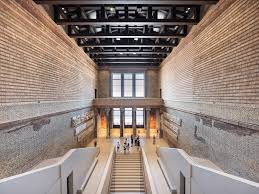
There is no way to commence my review of this exhibition without making mention of its host venue, the formidable, fantastic Neues Museum here in Berlin. Located in and among what is referred to as “Museum Island”, right beside the winding Spree River, the Neues is one of the most impressive, indomitable structures I have ever had the pleasure of visiting. I was unable to access photographs of this museum’s interior, but perhaps mere pictures would not really do it much justice; one would have to be a guest to truly appreciate the grandeur, the dignity, and the scale of such a museum. Europe is renowned for its majestic constructions, and this museum must surely be among the most impressive I have frequented.
It is perhaps the scale and the stateliness of the Neues which, admittedly, rendered the exhibition slightly underwhelming. It was difficult to locate, and it was only after a perusal of the museum’s floor plan (as well as an interrogation of a few of the security guards) that I was able to find the Burgsdorff exhibition once and for all, on the bottom floor, tucked away into a corner that had no signs explicitly indicating what it was, its significance, or even the fact that it was a special, temporary exhibition as opposed to a permanent Neues display. My attention was easily diverted by the surrounding sights, particularly those of the Egyptian burial ornaments and treasures.
[“Excavation on Schlossplatz” photo HERE]
The gist of this presentation was to present the life and death of Konrad von Burgsdorff, whose sarcophagus was unearthed in Berlin in 2009 during a nearby archaeological excavation at Berlin Palace Square, and subsequently became a central news topic. Apparently, this excavation had produced von Burgsdorff’s chosen burial ground, accompanied by a dozen or more coffins containing the remains of various family members from very young to well-aged. This display showcased many of the accoutrements of these departed loved ones, most specifically the role of garlands (head wreaths) as adornments of the deceased.
Up until this point–according to the few write-ups that were placed around the exhibition–Christian burials in Germany were simple occasions, unfettered by elaborate rites or decor, and this particular excavation had produced what was likely one of the first examples of death and the funeral process containing intricate mementos of ritual and ceremony.
[“Funeral wreath for Caroline” photo HERE]
The few glass display cases at this exhibition contained very delicate, fragile treasures that were salvaged from this burial ground–for lack of a better term–and I was seized by the feeling that one usually gets when gazing upon the remnants of a much earlier time: that of imagining the artifacts as they once were, or the people responsible for their construction, and putting them into a centuries-old context. I found myself gazing upon a swatch of silk, a number of rings, a handwritten, leather-bound book that contained the final rites of von Burgsdorff, and allowed myself to visualize that particular era and how these items were as important to this Christian burial process as the ornately-carved sarcophagi and elaborately-scripted papyrus scrolls were were to the ancient Egyptians (which were–incidentally–adjacent to this exhibition, and which seemed to dwarf the Brandenburg exhibition in terms of scale, appeal, and general points of interest).
There were a few key elements which stood out to me: the remainders of a coffin encased in leather, for example, were quite wondrous; these strips of black hide, studded with nails, have in modern times become a sartorial statement indicating rebellion, the underground, counterculture. A young man or woman garbed in nail-studded leather would more likely be found in a punk club than in an atmosphere exalting his or her aristocracy, but this was the chosen aesthetic for one of the children’s caskets.
[“Anthropologist examining girls of Rathenow” photo HERE]
The intact skull of a young woman was the highlight of the exhibition, encased as it was in one of the garlands that was, surprisingly, still recognizable and intact. Carefully nestled on some soft material, face-down and in profile, it took a few examinations from different angles to fully discern the position of this skull, the jawbone, the crown. As is always the case when looking upon human remains, I wondered about the cause of death, and whether or not this child knew that her burial was going to be the stuff of great ceremony and occasion. Again, these wreaths placed upon the head–which were reserved primarily for girls and unmarried women–seemed to be a central focus of this modest exhibition, and it was quite interesting to see the foliage preserved so well over the course of five centuries, although how the archaeologists and curators handled their evident fragility is almost as fascinating as the artifacts themselves.
[Photo of marble von Burgsdorff bust HERE]
The grand sarcophagus of von Burgsdorff was somewhat of a centrepiece of this exhibition, with his marble bust situated across from it, staring down at it; however, I did find the overall exhibition slightly anticlimactic, and wished instead to explore the magnificent Neues Museum and its other treasures on offer, which of course, I did.
This basement-level display of burial processes–from this modest Brandenburg display to the ancient Egyptians surrounding it–was neither morbid nor morose. In an artistic, attractive manner, it indicated to me how much more we need to take into account the importance of death and deliverance, particularly our own. This is not a depressing topic to ponder or discuss; in fact, quite to the contrary. Signifying or celebrating the life that we have lived up to this point through whichever means we find necessary–whether it be through studded-leather caskets, garlands upon the head, extreme chemical mummification, or simply being tossed into a deep hole whilst wearing our favourite T-shirt–is a ceremony that ought to be given more thought to, as it is the one inevitability in life that we can rely upon. Life and death are cyclical, and the process should never be regarded as anything but.
(Epilogue: I did, in fact, write my burial instructions in pen on cheap lined paper before I left Canada for Germany. I have now changed my mind about nearly everything, and hope that I don’t meet my maker before I get the opportunity to make massive revisions to that document.)
 verainvancouver@gmail.com