
As a modest tribute to one of the most intriguing filmmakers of the last few decades who would have turned 78 today–with a terrific blast of thick hair that even I envied, and an odd Midwestern sexiness that will always give me thigh cramps–I want to share one of my favourite quotes from David Lynch:
“Don’t fight the darkness. Don’t even worry about the darkness. Turn on the light and the darkness goes. Turn up that light of pure consciousness: Negativity goes.”
While he was the genius behind so many films and shows that manage to truly capture what dreams are like, it’s “Mulholland Drive” that had the biggest impact on me. I don’t even want to watch it again; I’ll never relive the emotions I went through the first time I experienced it. It was, and remains, simply perfect.
In Heaven, everything is fine, Dave.
* * * * *
Where were we? Oh yes. Alcoholics Anonymous and talking about meetings. I think we left off with the 12 steps, which–upon hearing people’s stories–actually seem to be more like a creaky old treadmill, since the common approach appears to be that once you’ve made it to the twelfth step of enlightenment and spreading the gospel, well, you start them all over again! Back to reinforcing to yourself that you are indeed “powerless” it is, then.
The curious thing about these twelve steps is that only a single one talks about alcohol, which is the first one: We admitted we had become powerless over alcohol; our lives had become unmanageable. Everything after that becomes pure indoctrination into what could arguably be deemed a cult, one that reinforces self-flagellation, humiliation, repetition of rituals, and an ongoing belief that members are wrong and only Bill W. and the program are right…which we will get into later.
After the meeting has kicked off on time, you might notice–as you look around–what are called “old timers” in AA parlance. These are the usually-superannuated AA devotees who have been coming to meetings for years, usually sit in the same seats, hold court over the proceedings, demand respect and sometimes even deference, believe they know better because they allegedly have years of sobriety amassed, and don’t hesitate to make newcomers feel like worthless animal waste if they believe it’s good for them (and animal waste often has a purpose and is not, in fact, worthless: how else would the most self-righteous, fanatical vegans get their vegetables? Actually, don’t even ask them, because they’re so accustomed to doing intense mental gymnastics in order to justify their superiority complexes, it’s like having a conversation in Khmer with a Slovenian acrobat)
Let me give you an example: I recall a meeting I attended where someone was asked to speak, and he was newly-sober. The guy was probably around my age, and I found out he also was an ESL teacher. In fact, unsurprisingly, in this meeting of about twelve people, four of us confessed to having engaged in that form of modern slave labour, which was exactly one-third of the alcoholics present, which tells you plenty about that line of work and how we all ended up with a severe drinking problem. As he spoke, he mentioned he was just under a month clean.
“I guess,” he concluded shyly, “the thing I can’t really get used to is how bored I am. I’m so accustomed to drinking and having alcohol around as company, so dealing with the boredom has been a big issue. Thanks.” He returned to his seat, as this was a podium meeting, and I understood him completely. Once you remove something that has been a prominent obsession and dependency from your life, you’re often not sure of how to fill your days. Despite all of alcohol’s problematic qualities, it is often a source of company, a void-filler, a way of feeling temporary euphoria and escape for those who have become hooked on its easily-accessible lure. It is a bona-fide relationship between you and the bottle, and breaking it off is as impactful and traumatic as any connection you have had to sever between you and another human being.
(In AA, by the way, there is no “cross talk,” meaning no discussions or conversations. Everyone who speaks is presenting a monologue; some keeping it brief and halting, others so eloquent and captivating it’s as though they’re reading from a teleprompter. It is literally one hour of unprepared presentations in which God, the twelve steps, and the importance of sponsors are repeated again and again, and very little else.)
The facilitator, an old timer, absolutely eviscerated this man when he took the podium next. “You know,” he growled, “you talk about being bored. Let me tell you about Shelly, who used to come to these rooms for decades. She was so happy about not drinking, about having all of us and having God keep her sober. We loved her. We thought she loved life. Last September we found out that she had walked to [some bridge] and jumped to her death. So I’m telling you,” continued the old man, pointing a crooked finger at the newbie, “you have no business being bored. None.”
I mean, this fellow just angrily gave a relative newcomer a severe public dressing-down in a place you’re supposed to feel safe with revealing your vulnerabilities and concerns (and where, you will learn, you actually aren’t really safe at all). I saw the poor guy’s ears turn bright red as he took it. I most certainly wouldn’t have. In fact, I probably would have walked out of there, raging, and gone to the nearest liquor store for solace, since that’s how we vulnerable alcoholics deal with our emotions. Getting shamed by some old anal wart after I was brave enough to be raw and open in front of strangers about my drinking? Where’s that bourbon?
These old timers are also renowned for repeating the AA slogans on an ongoing basis, of which there are hundreds. These include:
First things first
But for the grace of God
Take the cotton out of your ears and put it in your mouth (a demeaning statement meant for any newcomers who think they have anything of any consequence to contribute)
Let go and let God
Easy does it
Live and let live
It works if you work it
Nothing changes if nothing changes
Think, think, think (very Winnie-the Pooh!)
After “How It Works” is read, the facilitator will ask if there are any newcomers, or any out-of-town visitors, or if anyone is returning (which means relapsed and are now back in the rooms). I never raise my hand and call attention to myself; I won’t do it.
Then the facilitator will ask if anyone has logged any sober time, such as ten years, five years, a year, a month, even twenty-four hours. One specific meeting I attended a few times had everyone clap their hands once after each length of time was announced (“Anyone here with one year.” CLAP. “Thirty days.” CLAP. “One week.” CLAP. It was an oddity I hadn’t encountered at any other gathering.)
The facilitator then might have some topics prepared, but in my experience, they ask attendees if there is anything they want to talk about for that meeting. People will call out ideas:
“Humility.”
“Gratitude.”
“Honesty.”
“Step one.”
Those are some of the most common suggestions. Ultimately, though, the topics themselves are so broad, you can sort of talk about whatever you wish if you’re asked to share.*
*This actually isn’t true, which I will address momentarily.
I wonder why Step One is so frequently used as a meeting topic, but I think it’s because it opens up the rooms to the alcoholic equivalent of pure porno chat; people absolutely love to share their war stories, how their lives had become unmanageable, how powerless indeed they were over the poison. You will hear many, many tales of people who had high-ranking careers, intact families, more money than Musk, the loves of their lives, and lost it all to Stolichnaya. Because they couldn’t put down the bottle, they drained their life savings, lost their homes, stole from their elderly parents, lost their kids, ended up on the streets, wound up in jail, got stabbed multiple times, attempted suicide, developed a meth habit on the side, were irredeemable.
Until they found AA.
The war stories are, indeed, fascinating. If you’re coming to the rooms for the first time, you’re most likely feeling subhuman, sick, defeated, and spilling over with guilt and self-loathing. The things that happened to you because you got hooked on spirits may have been appalling, but you can guarantee that at least one person in that meeting has had it far worse than you. You’ll think to yourself, Christ, at least I didn’t get that bad. Maybe I have a chance. I did some unforgivable things, but I never did any of that. Truth be told, it’s comforting. You will see a lot of yourself in other people, as they will in you when everyone’s just sharing their tale.
These aren’t lies or performances, either. These are impassioned accounts of very real, very rough and unchosen lives. Above all of the in-person stories I have heard in AA, one of the most eye-widening stories I’ve ever heard about true alcoholic slavery and bottoming-out was in the book Wasted, a memoir by Michael Pond, who is a therapist based here in the Lower Mainland. The absolute plummet from grace he details in the book is almost not to be believed. He was living an incredibly comfortable life as a successful psychotherapist and addictions counselor in the interior of B.C., and ended up a ravaged alcoholic in just a few short years. Small excerpt:
A client from my Employee Assistance Program contracts came to my office and knocked on the door. I heard her. I lay on my couch, sick with detoxing and so hung over I couldn’t possibly respond. She knocked over and over and over and finally I staggered to the door and flung it open. “Oh my God, you’ve been drinking,” she said. She fled.
I began to call in sick, telling my staff to cancel all my clients and reschedule. “I have the flu.”
I’d get up after a day or two and still be half-loaded. Couldn’t go in. Called my staff again and told them to cancel and reschedule again. And again. One night I broke down the two doors to my office because I needed a place to sleep. An early-morning client walked in through the smashed-in door frames and found me passed out on the leather loveseat. The next day, four resignations sat lined up on my desk. All my staff had quit.
-Chapter 4, “Getting Here,” from Michael Pond’s Wasted
He loses everything. His wife, his kids, his stunning home on Lake Skaha, and ends up homeless on the downtown eastside of Vancouver, pawning his thousand-dollar laptop for twenty bucks to quaff a few tall cans of beer in order to stave off withdrawal. It’s a book written with fact, conviction, honesty, and no sense of self-pity or victimhood; it is, simply, a harrowing, mesmerizing read. He eventually pulled it together and rebuilt his life, but not without an enormous struggle.
As I’ve said many times, this can happen to anyone.
* * * * *
I mentioned somewhere above that if you’re asked to share at an AA meeting and you agree to do so (you are under no obligation to speak; you can simply come and sit and listen and say nothing, which many people do), you can say whatever you wish. This actually isn’t really the case; at least, not if you think you will escape consequences. The story I told above about the old-timer berating the newly-sober ESL teacher because he admitted to being bored in sobriety is simply one tiny example of repercussions you will face if you do not adhere to the AA structure. It is a most egregious and abominable example of a terrible member of this supposed fellowship, but it is indeed an example of how the rigidity and hierarchies which permeate the organization are unavoidable.
I will reiterate this until someone throws a brick at me: AA is not where you go for group therapy or for help with the medical issue of alcohol addiction. AA is not actual therapy, is certainly not a place where you can sort through your drinking issues, talk about how hard it is to stay sober, about your relapse last weekend, and that you’re going to keep fighting the good fight and get over the addiction with the help of your therapist, your doctor, and maybe even some medication because you might actually be depressed, too.
Not a chance. You know why? Because if you’re still struggling and relapsing, you’re not working The Program and you need The Program. If you’re sober and doing well and turning it around, it’s because of The Program. If you’re working The Program and still having a tough time, well…it’s your fault, it’s not The Program. The Program is without flaw, and you cannot question it.
I mentioned in my first piece that AA is about The Program, and talking about The Program, and endorsing and celebrating The Program. Medication, doctors, therapists, and modern-day compassionate approaches towards addiction have no place in nearly century-old Alcoholics Anonymous. It is the ritual you must repeat again and again in the rooms, it is the 12 steps, it is its founder Bill Wilson (a messianic figure in the AA doctrine), it is the Big Book (the sometimes-revised, heavy tome that is considered AA holy scripture), it is finding a sponsor and dedicating every waking moment of your life to completing the steps alongside a sponsor (an individual given unmerited powers over your life who is, realistically, in every danger of relapsing just as much as you are).
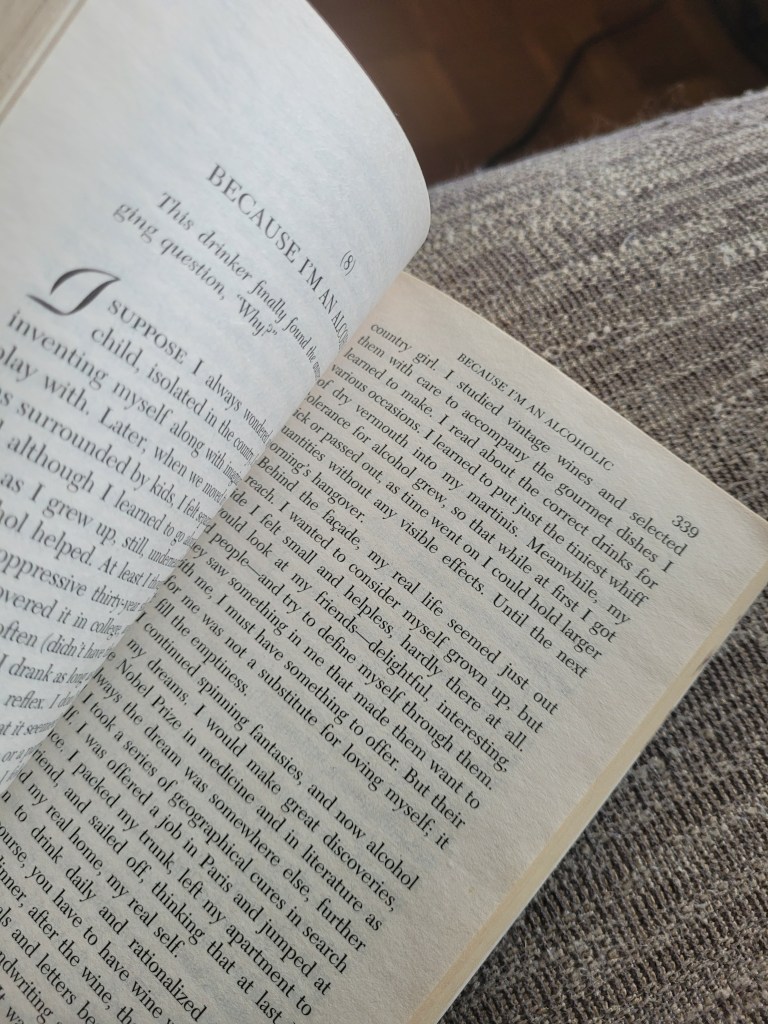
Only halfway through the Big Book.
I have shared at AA meetings many times, mainly because I’m a former teacher and performer and actually don’t mind an audience at all. I like to talk, and I’m a fairly good storyteller. However, with every share, I must be careful; I must be aware of what I’m saying. I may tell horror stories, some of which I can’t even reveal here because I don’t actually want people I love to know about some of my questionable shenanigans, but which I can spill out at length during a meeting. I enjoy this part; I like the fact that I have been a profoundly rat-arsed idiot in the past, and can tell these anecdotes with humour or humility, looking at a sea of accepting and nodding human beings, sometimes even being met with laughter or comments afterwards that they loved what I had to say. It’s liberating; I won’t take that away from AA. I won’t.
If only it were just about that; if only you could just keep talking about your struggles, and thank the people present for their support and understanding, and how no matter what, you know you’ll get through this madness.
You can’t do this. If you’re not working The Program or quoting the Big Book or doing the steps alongside a fellow alcoholic sponsor, there’s a sort of unspoken frustration that goes through the room as people quietly wonder what on earth you’re even doing there if you’re not working the program. They say “Take what you want and leave the rest behind” as one of their endless slogans, but this is the furthest thing from the case.
I have to also clarify something, which is the fact that discussion of God is prominent and ongoing in these rooms. I’ve got no issues with this. None. It is actually a relief and a delight to be in an environment where you’re not scorned or ridiculed for talk of God, or your faith, or your personal, complex spirituality. I believe in God, and I don’t owe it to anyone reading this to explain what I mean by that. I was not raised in a church or with a bible or with any talk of Jesus; I was raised as a modern-day Doukhobor (as Kris Novoselic gleefully, maybe naively described when being interviewed by Nardwuar decades ago, “Doukhobors are awesome!! They’re Christian anarchists!”), and you can do your own research on what that is all about. My relationship with God–like your relationship or lack thereof with God–is personal and very real.
As AA likes to say, “ God as we understand Him,” as though to emphasize the idea that God can be your cat, a doorknob, a meme on TikTok. AA adherents say this all the time; that God isn’t biblical in The Program, isn’t an almighty force, can actually be anything you want and up to your interpretation. They say this, but they don’t really mean it. There appears to only be one understanding of God in AA, and that is the AA God. The one keeping you sober. The one swinging you back to sanity, because you’re insane, as you declare in Step 2. The one who will remove your moral failings and shortcomings and weaknesses and keep you coming to meetings for months, years, decades, because to not do so would mean you have failed, and you have failed The Program, and thus, you may have actually failed God.
Okay, I’m done. I could write about this forever, and I just might. I’ll continue this, hopefully conclude it next time. In the meantime:, enjoy some absolute haul-ass.
Love
Nadya
 verainvancouver@gmail.com
Leave a comment