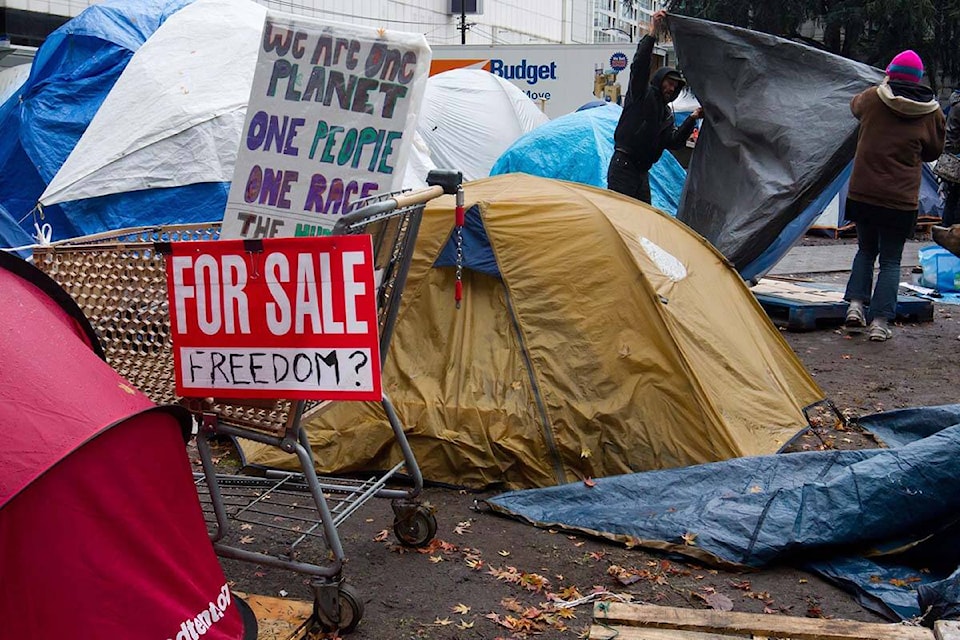
It’s not dangerous, really. It’s not the sort of place you want to go–and, in fact, should be avoided as much as possible–but you’re not really at much risk. If anything violent does happen to an innocent pedestrian or local employee, it’s news-worthy: it’ll be reported endlessly by the six o’clock talking heads, or plastered all over the Vancouver subreddit (which, I’m going to remind you again, I’m permanently banned from). You can make your way through there without too much trouble, as the residents of the downtown East Side are much more preoccupied with other matters than a person simply passing through.
I’ve described it before as littered with human shrapnel, because there’s no better descriptor I can think of. If that sounds disrespectful, I hold myself accountable for the connotations. However, it’s difficult to walk through there without viewing so many people as broken, as torn-apart, as contorted limbs and faces and visible wounds all over their flesh; folded over from their waists, shivering, hollering sometimes, staggering about, sometimes literally walking in circles, as though they are pacing an invisible rug. Shambling and jaywalking across Hastings Street without any regard, or even awareness, of vehicles and traffic lights, causing drivers to clench their teeth and brake and allow these people to cross; sometimes swiftly, sometimes with a great deal of effort.
I decided to take a walk through there this morning, to take the long way to my shop in Chinatown that sells the tea I like. What I usually do is walk through downtown to Stadium-Chinatown station, jog down the big staircase next to it until I’m at the T&T Supermarket roundabout, shortcut through the mysterious, strange International Village Mall, and then head up Pender to Main, which is where I need to go. Today, I don’t know why I felt like making the small detour to Hastings Street and work my way through that community. It is one street parallel to Pender–just in front of it–but it could be a different city, country, solar system.
I pass through there once in a while on the bus to East Van, and it’s extremely difficult to not rubberneck through the window, to not stare as you ride past the few blocks: the girls, young enough to be my daughters, clad in cheap tight clothing and covered in scabs, bright and garish makeup clumsily smeared on their lids and lips, so thin, so anemic, some of them attempting to walk with dignity in flimsy high heels, some of them simply sprawled on the sidewalk. The boys–and so many of them are mere boys–stomping aggressively or limping while bent in half, many of them without shirts or sweaters, filthy jeans falling off their emaciated bodies, occasionally showing an explosion of aggression in the form of a verbal outburst or a swift kick to a lamppost. But mostly, they are not present, they are barely clinging onto humanity, they are scary. Not scary because you feel threatened: scary because you haven’t really seen a person morphing into and acting like a very feral animal, and both the brutality and helplessness of his gestures.
Public transit will whisk you past this in a matter of mere minutes, giving you an opportunity to stare, ashamed but unable to look away, and then it’s done. You’re on your way to Commercial Drive, or to Nanaimo Street, or maybe you’re even going to SFU, because that’s the terminal point for this bus. It’s a blip of madness on your journey, especially when you take into account the fact that you’ve come from a very wealthy, dull, sterile downtown starting point, and then you’re met with the worst juxtaposition: a historic, beautiful, admirable stretch of downtown Vancouver whose infrastructure and architecture should be preserved and respected and maintained, but which is sullied and defiled and left to decay as its residents do not have the capability to take care of themselves, never mind the heritage buildings among which they’ve placed themselves.
I walked through it today, just because I wanted to. I have been dealing with very privileged, very sheltered people for a while now, and I needed to remind myself of the real Vancouver. When I taught ESL in this city, I would take my students on field trips (always the lesson plan of fed-up or hungover teachers, along with watching movies for language practice) through the downtown East Side. The students had all come to Vancouver because of the propaganda material their agents had provided them in their native countries. It’s stunning. It’s safe. It’s outdoorsy. It’s pretty. It’s mountainous. It hosted the Olympics. It has great restaurants. It’s rich. It’s diverse.
It also has a neighbourhood situated only a mere few steps from a sports stadium that spent over 500 million dollars for a light-show roof, and this stadium is used only a handful of times per year. This neighbourhood is allegedly the poorest postal code in Canada, and there is a poverty industrial complex ensuring that it stays this way. My students were in utter shock as we walked through this area, but they were safe: as I said, it’s not really that dangerous.
It took me about ten minutes–I am a speedy walker–to get through the few blocks of East Hastings before I swung right on Main to get to my destination. I wouldn’t dare take a picture, because this neighbourhood isn’t a zoo, and because I’m not going to snap photos of people without asking their permission. And if I can be honest, I didn’t want to approach a single individual and ask if I could take a snapshot and then post it publicly.
I had a high school friend who ended up there. Her name was Allison. She was a troubled girl, although very funny and very smart, and had relocated from Winnipeg. She was part of the suburban punk rockers that were my crew, and very popular with her tiny body, large breasts, and beautiful face that could have been painted by a more straightened-out Renoir. We had a close friendship, but she could not pull it together: whatever trauma she may have endured in her early years simply overwhelmed her. Meanwhile, I had transferred schools and was thriving in my directing and scriptwriting class (who knew there even was such a thing?), while Allison decided to give up on graduating and, instead, spent her time in East Vancouver at a very infamous bar called the Ivanhoe.
We lost touch, and the next thing I knew, she got hold of me when I was around 19 and she was 21. I can’t remember how. She came over to my apartment in East Vancouver, as I had moved out of my family home very early, and I hadn’t seen her in months. She had shaved her head by this point, and told me straight-up that she was a heroin addict. There was no visible or audible dysfunction that I could discern; Allison almost seemed to be determined to be this way. She had always been stubborn and straightforward, and this chosen addiction and lifestyle were integrated into those two qualities. She then asked if she could shoot up at my place, and I agreed: I had never seen this before. Allison pulled out a rig, borrowed a spoon, did the ritual, and injected the drugs into her arm. Despite taking a hit of heroin, I don’t recall her nodding off. I don’t recall her being doped-up and catatonic. That characteristic determination and strength and control she had always demonstrated seemed to prop her upright no matter what she did to herself.
The next time I saw Allison was about two years later, around Broadway and Fraser. She looked utterly awful, dressed in tacky, outdated clothing she would never have considered when we were high school friends and believed we Coquitlam punks would change it all. Her face was drawn–although her complexion was still legendarily flawless–and she seemed disoriented. Running into her was awkward and painful for me, but she seemed unfazed and happy to see me. She revealed that she and her boyfriend crawled into dumpsters and sold the clothing they might find there, and she was also escorting. I asked her if she was still doing heroin. She replied that she was, but they were working on a treatment program.
I’ve tried Googling her many times over the years. There is no information about her.
This is how it starts, I guess. I have been guilty of judgment, of lack of compassion towards those who are so exasperatingly unable to get a grip, get it together, find direction. Who have developed addictions that overwhelm all of their common sense, all of their duties and responsibilities as parents and workers, who are slaves to the dopamine rush and ritual. And that’s what it is, isn’t it? It’s slavery. Whether it be through alcohol–which is pushed onto proletariats such as myself as the solution to your drudgery–or the hard stuff, which is now given to active addicts in this city, encouraged, with a finger-wagging message of “compassion” in the direction of anyone who dares to question it. Rather than the four pillars system that is proven to work, there is one pillar in place here in Vancouver: harm reduction. We provide the drugs and the safe space in which to do them–in fact, decriminalize their use–and then you are on your own. No push for treatment. No enforcement. Nothing of the sort.
I looked around at these souls, and realized that I am just one lucky break, or one good family away from joining them myself. But how do you pull yourself out of this hellish rut without any motivation from the state? When the state is fully enabling you, how will you ever have the means to find the strength to stop? Stop the addiction, the squalor, the selling of your body to others, the utter lack of decency that every human being on this Earth should be afforded?
The state is taking the human shrapnel, blasting it apart just a little bit more, with a little bit more of what destroyed them in the first place, and then walking away, dying flesh and minds in their wake, just so many casualties who don’t even know that they’re actually very much dead. Fluttering in the East Vancouver rain and wind, oblivious to the elements and their surroundings, like so many unwanted, unknowing litters of innocent animals.
(Reach me at nadya@nadzvera.com)


 verainvancouver@gmail.com
Leave a reply to huddlesan Cancel reply