
I am not referring to the job market, the cost of living, or the misanthropy of the residents in my particular neighbourhood, although any of those would be perfectly acceptable as material for this topic. I am talking about an architectural movement that has been an object of mild fascination for me ever since I became aware of it a couple of years ago: Brutalism!
In 2022, I finally had the means and energy to take my first vacation in a truly long while. I flew over to England for a much-too-brief eight days, although I was pleased to be able to go anywhere at all for any length of time. For reasons not worth detailing here, I unfortunately spent the greater part of my visit in the absolutely wretched town of Middlesbrough, but I also got to hang out in beautiful York for a day (although it happened to be spring break, so the narrow cobblestone streets were absolutely crammed with “Harry Potter”-obsessed tykes and their parents who made the entire experience an exhausting and, ultimately, unsatisfying one).
I made sure to spend my last few days in England by hanging out in London, which is my favourite city in the world, and which I hadn’t visited in over two decades; and while those few days couldn’t possibly provide enough opportunity to really absorb that fabulous metropolis, it’s actually pleasantly surprising how many activities and places you can stuff into a single day if you’re armed with determination, specific destinations, a comprehension of the Underground tube system, and a sense of direction.
One place I wanted to visit was Portobello Road Market in West London, having read about it ages ago, and I knew it was slightly off the typical tourism beat. After bumping into some Trotskyites at the tube station and wandering through the excellent stalls–I found a vintage UK Penthouse mag from 1970, paid a few pounds for it, and saw that, interestingly, it was strictly topless-only pictorials for the models; a far cry from the lewdness and raunch that characterizes the US version–I meandered a little bit further in the Kensington / Chelsea area to find a public washroom.
Then, among all the vendors and antiques and bohemian shops and neat little cafes and smells of burning incense, this…building loomed directly ahead of me.
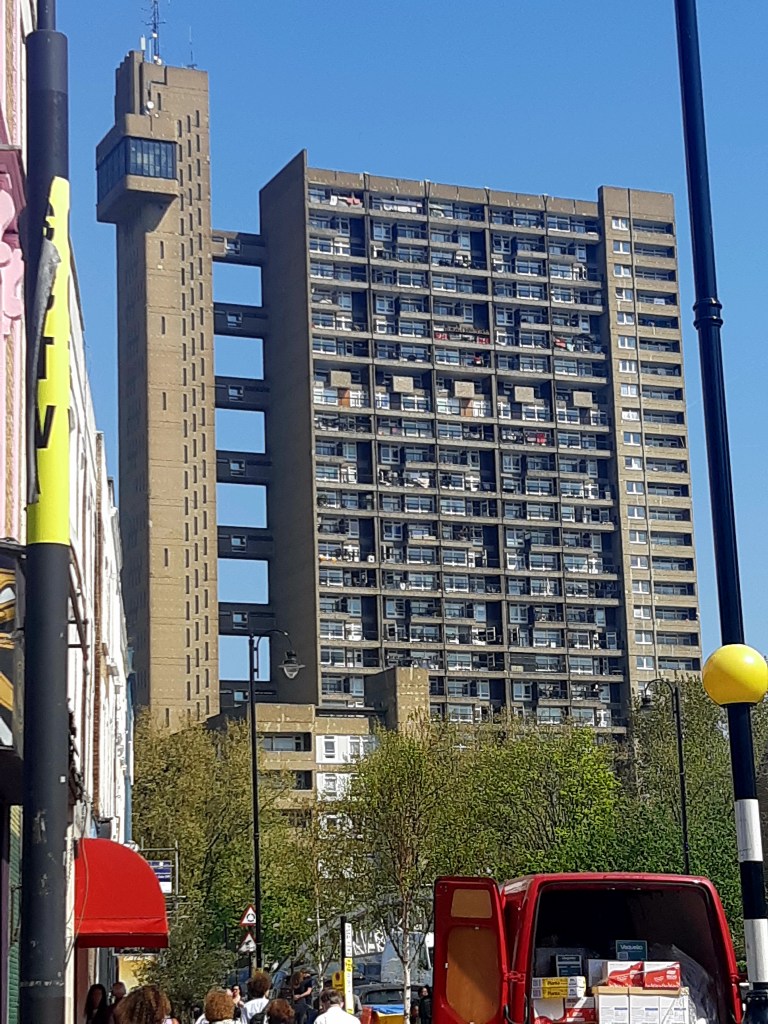
This just didn’t make a lick of sense to me on that sunny London afternoon.
I had never seen anything like it before in my life. It looked Soviet-era stark, Mexico City-style cramped, and “Blade Runner”-esque alienating. I couldn’t stop gawking at it as I walked; I couldn’t figure it out, couldn’t make sense of what was going on, and I finally just stopped moving entirely to stare before taking the above picture.
“That’s Brutalist-style architecture,” said the person I was with.
“Brutalist?”
“Yeah, it’s Brutalism.” He didn’t really expand past that, but it was the first time I had ever heard the term in association with an architectural style. I became instantly intrigued, and wanted to learn more about Brutalism, coming from a city where there are multitudes of generic, artless, fragile high-rises that likely don’t belong to any notable architectual styles or movements…and if they do, these approaches to design and engineering are tragic, fleeting, and wholly unsustainable.
(I have also since learned that this London building is called Trellick Tower, and it features on many websites depicting Brutalism in the UK.)
What I do know about Brutalism is that it originated in the UK during the 1950s, so I was in the presence of a building that had been constructed in the actual birthplace of this architectural style; essentially, I was at Ground Zero for Brutalism, and had the unknowing fortune to behold an authentic example of UK Brutalist design and construction. It was a post-war, inexpensive reconstructive style that meant to utilize minimalism in design and material, typically using exposed and unadorned concrete. It very much resonates as some kind of totalitarian, fascist motif, but it also could represent a very straightforward representation of practicality, commonality, and class neutrality.
While mostly used for social and council housing in the UK, its use and style eventually spread around the world to legislative buildings, universities, and city halls, all of which now makes perfect sense to me: there are, in fact, a few examples of these throughout Vancouver, and I had never paid them much mind until I was introduced to the concepts of Brutalism.
I recently spent a day meandering throughout downtown and West Side Vancouver, taking photos, and came up with some Brutalist hits; while I think the word “iconic” has been overplayed and whittled down into meaninglessness, these structures are immediately recognizable, well-known to locals, and indeed, defiant icons of Brutalism in the City of Glass.
- * * * * *
805 West Broadway (or, the Frank Stanzl Building) is twenty stories tall, was completed in 1974, and continues to silently, proudly stand among chirpy businesses and restaurants and banks and an ever-changing major street perpetually under construction. Despite all of these ever-shifting circumstances, there is hardly a chance of it wearing down or, really, even dating itself; it is timeless, bold, and fearless.
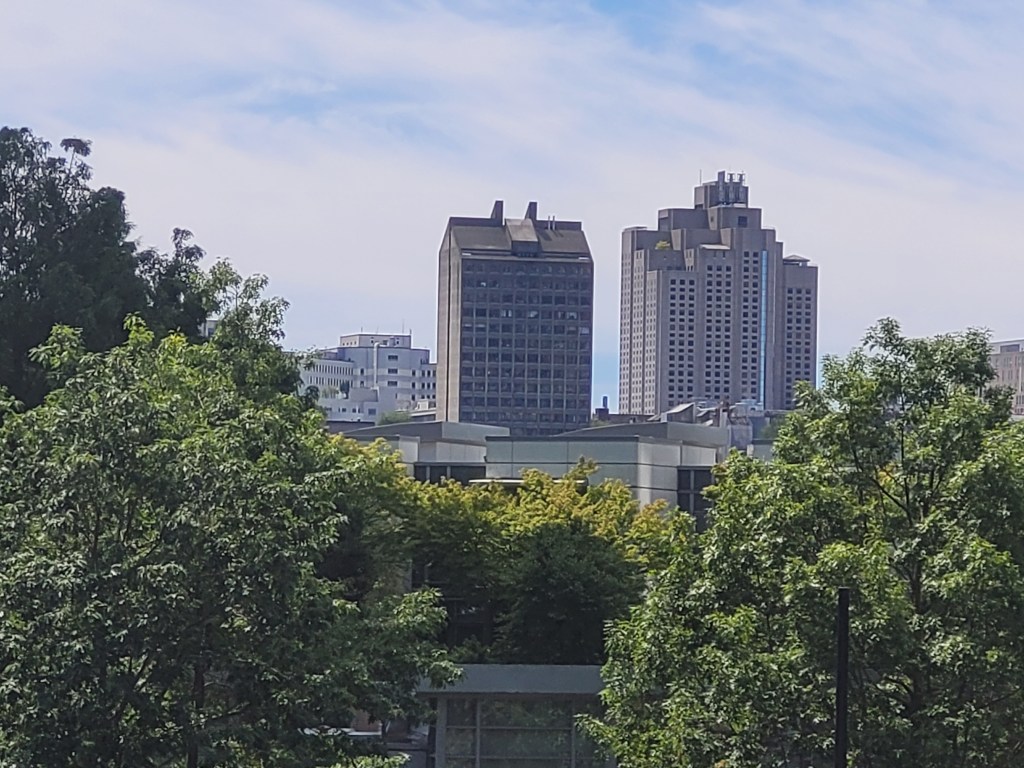
Everyone knows this edifice; it has even shown up in my dreams throughout the years.
805 West Broadway is one of those buildings that has always seemed to be there, and the low skyline of the endless street would be frighteningly naked without its presence. Within its surprisingly airy interior are myriad medical offices and practices, including dentists, optometrists, and even penile-enlargement services. Twenty years ago, I went a slightly different route from the latter, visiting my surgeon a few times in this building when I decided to get a breast-reduction operation (one of the best decisions I have ever made in a life characterized by eye-rolling choices). My surgeon, the crisp and efficient Dr. Sproule, apparently has since retired, but she changed my life in a most fundamental way. So in a sense, I associate the iconic Frank Stanzl building with my breasts: may they both forever stand at attention.

Another perspective of the Broadway Brutalist.
A few blocks up and a few blocks west–on Cambie and West 12th, to be accurate–is City Hall. While this was apparently built in the 1930s (which is evident in its overt Art Deco style of reinforced concrete and geometric ornamentals), I will die on the hill that this was a precursor to Brutalism. Vancouver at the beginning of the 20th Century was still a somewhat-backwater logging town; fancy-pants architecture and ornate embellishments for its civic headquarters would have been a waste of everyone’s time. Keep it practical, and keep it solid.

Somewhat Brutal, in my esteemed opinion.
Looking down from City Hall, you get a fairly nice view of downtown Vancouver: our famous mountains, our infamously unimaginative and fragile buildings (I really do dislike them), and the spikes jutting out from the roof of BC Place Stadium, whose replacement for the 2010 Olympics cost $514 million, and which is located a couple of blocks from the poorest, most shamefully exploited neighbourhood in the country.
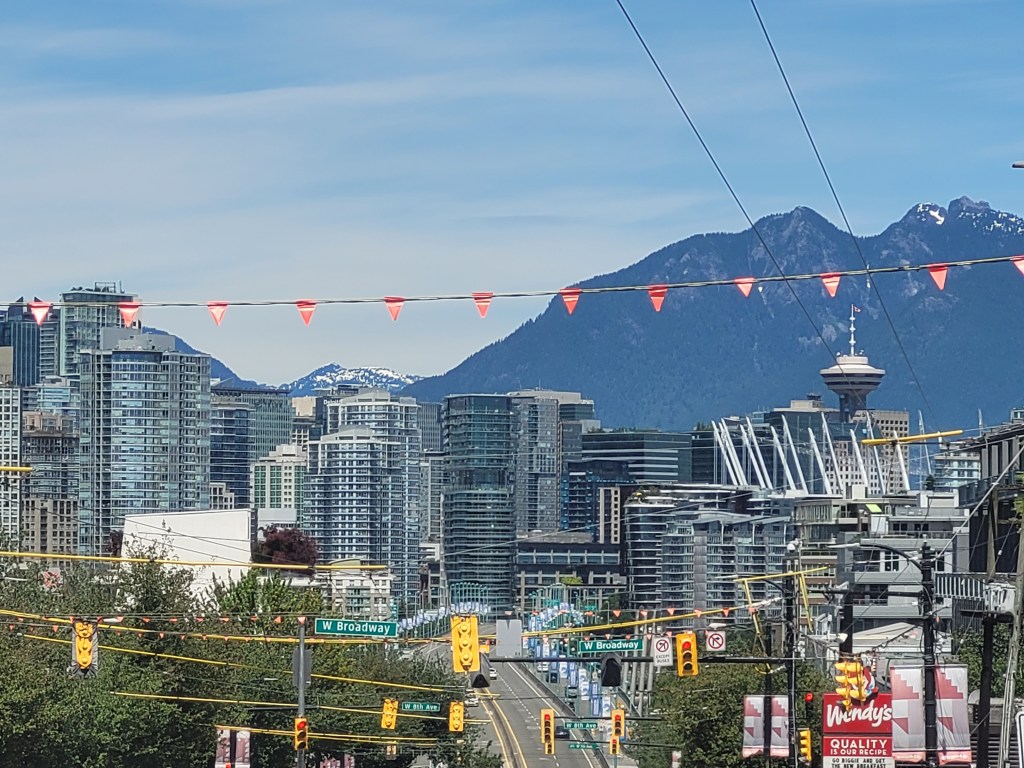
Can you spot the Brutalist architecture?
Heading right downtown to the intersection of Hastings and Seymour, we have a building that is–bear with me–really iconic. I mean, it is immediately recognizable to locals and tourists alike, usually photographed alongside Canada Place and its identifiable white sails (which bores me silly). Lads and lasses, let’s take a moment to really celebrate Harbour Centre, the Eiffel Tower of Brutalist architecture in Vancouver.

Why is this unsettling to me as an adult, in a way it never was when I was a kid?
This was considered a skyscraper in 1977 when it opened, and while it’s since been dwarfed by generic and unremarkable structures, it is still very much a prominent part of downtown Vancouver’s skyline. The Brutalist concepts are very much at work here, innovated by the inclusion of an exterior lift going to the top of the lookout. This would omit the need for elaborate, highly-decorated lobbies and elevator banks, instead keeping with the utilitarian ideals of aesthetic neutrality and and overall practicality.
As teenagers, my friends and I would come downtown regularly to hang out, and one of our stunts involved finagling a free ride on this elevator: “We’d like to just go up and check out the menu since I think we want to have dinner here,” we would say to the concierge, all of us resplendent with our nose rings, Black Flag T-shirts, green streaks in our hair, combat pants, and bomber jackets. They would smile and allow us to take the elevator trip to the lookout for free, which back then was about twelve dollars (I miss everything about the 90s). Now, the cost of a ticket is hovering around twenty bucks, which actually isn’t too horrible of a price-jack from 1993, and the restaurant menu is solidly on display at the base of the elevator. I’d like to think my friends and I had something to do with that decision.

I don’t even want to tell you what I had to do to get this shot.
One block west and one block north of this landmark, right at the waterfront, is 200 Granville Street, home of the Vancouver Sun and Province newspapers. It is a nondescript, entirely uninteresting building, but since I have arrived at a place in my life where I’m constantly scavenging around for examples of Brutalist architecture everywhere I look, I conclude that this one is, indeed, in adherence to the main pillars of Brutalism, although with its unimaginative rectangular shape and depressing hue of beige, it’s far blander and less commanding than its brethren throughout the city. Let’s put it this way: if someone were to finally tear down 200 Granville Street, nobody would shed a tear, and nothing would change.
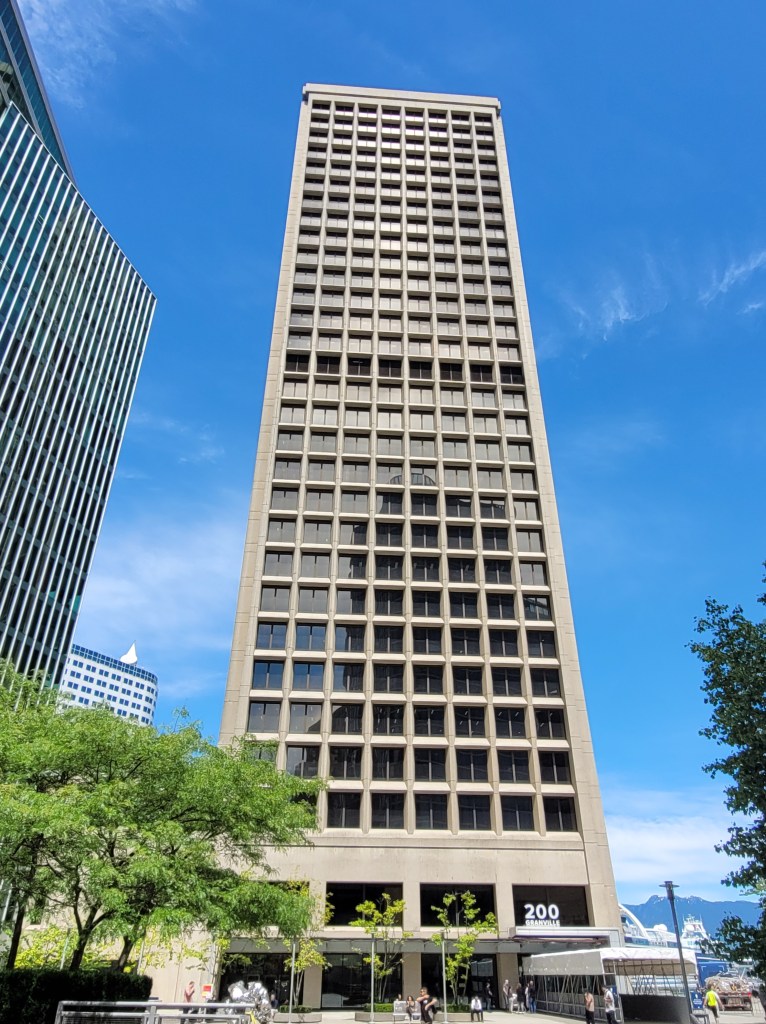
Brutalism at its most banal.
It’s just an office building, really, and its interior is as unmemorable as its exterior. I’ve been here a few times in my life. Our old property management company had its head office in this building, and I had to pop in a few times to inquire about changes in rental payment policies, as well as complain about an old building manager who literally did nothing except sit in Jim Deva Plaza and drink himself into soggy oblivion from morning until night.
I also attended a job interview here one time, for a company whose purpose and description I still couldn’t make sense of no matter how many times I read and re-read their website. Something to do with technology and ions and batteries and…actually, who knows. The job role was focused on editing and putting together business proposals for the organization, something I would have been happy to do, except everything was a disaster: the interview was ridiculous and went nowhere, the owner kept rescheduling me and then didn’t even show up for the interview–sending a flustered assistant in his place–and the salary was what you’d pay an intern, as opposed to a university grad with several years of teaching, editing, and administrative experience under her belt.
Finally, we get to our Brutalist Acropolis: perched atop Burnaby Mountain with a 360-degree view of the Lower Mainland, we have my alma mater, Simon Fraser University, which opened in 1965. I always thought it just looked like a prison, or an army base (and indeed, it has been used in countless movies and TV shows to depict exactly those two institutions), but I now know that it is a Brutalist masterpiece by the famed local architect Arthur Erickson. This campus would denote his commitment to using concrete, something he said was his most beloved building material, one that he treated “as a precious material…the marble of our time.”
(By the way, I didn’t take these photos of SFU; schlepping out that way and up that hill just wasn’t going to happen on this Brutalist day of respect. Credits go to the official Simon Fraser University website.)
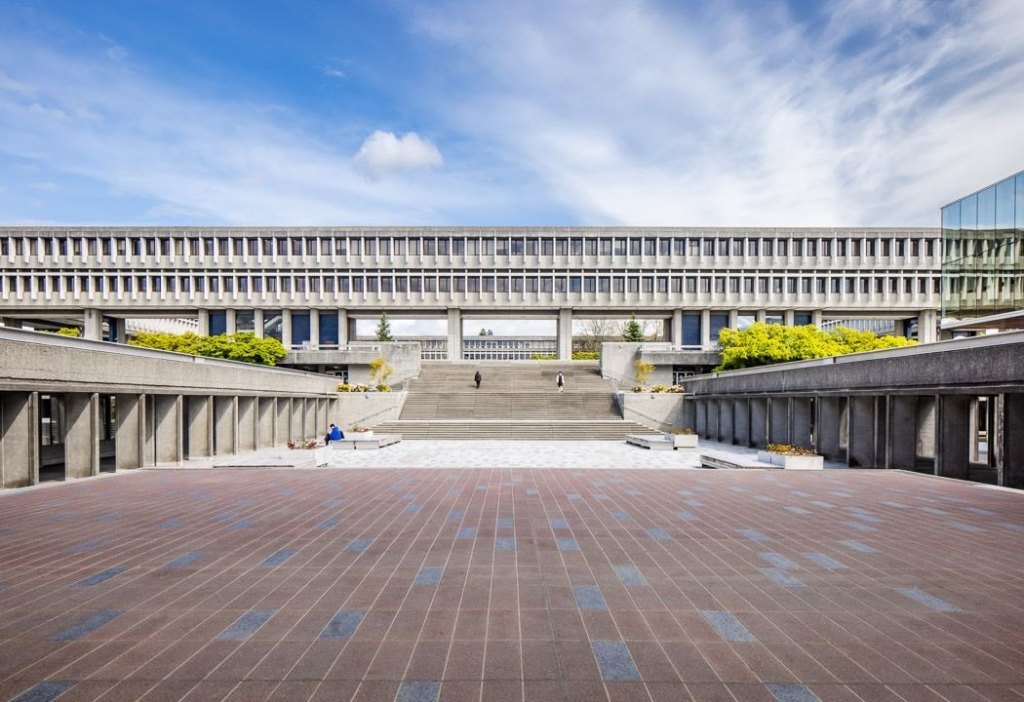
They call this “Modernist Megastructure,” but I’m no fool: I graduated from here, I know things. This is Brutality!
I need to include a small personal blip here, because I really loved everything about my time at SFU in the extremely-early 2000s…
After a couple of years getting my Associate of Arts degree at Capilano College (now Capilano University), I transferred to SFU and didn’t take a single semester off until I graduated. I initially double-majored in Sociology and Anthropology until I realized I would never, ever pass the requisite Statistics course needed for Sociology. I scaled back and focused on Anthropology, until I took an obligatory course on the Zapatistas that drained and disinterested me so heavily, I heaved the most dramatic of sighs and switched to English and that’s what I finally majored in (see somewhere above re: lifetime of terrible choices).
SFU was a terrific place, a terrific school, and the minimalism and straightforward nature of its architecture seemed appropriate for focusing on education. At the time there was nothing on Burnaby Mountain except this exemplar of Brutalism; not a single bit of student housing, no restaurants, no shops, nothing of the sort. There was one lone pub, and several cafeterias throughout the joint. You just went up the hill to attend classes, and then you went back down the hill to go home–no distractions, no being tethered to the campus. It was a genuine community, an easy place to make friends, an unpretentious haven in which you could focus on everything that was important to you.
SFU is entirely different now–a legitimate, very developed university town in its own way–but when I attended, it was a Brutalist way of focusing on your studies, and I will forever be grateful for the experience.
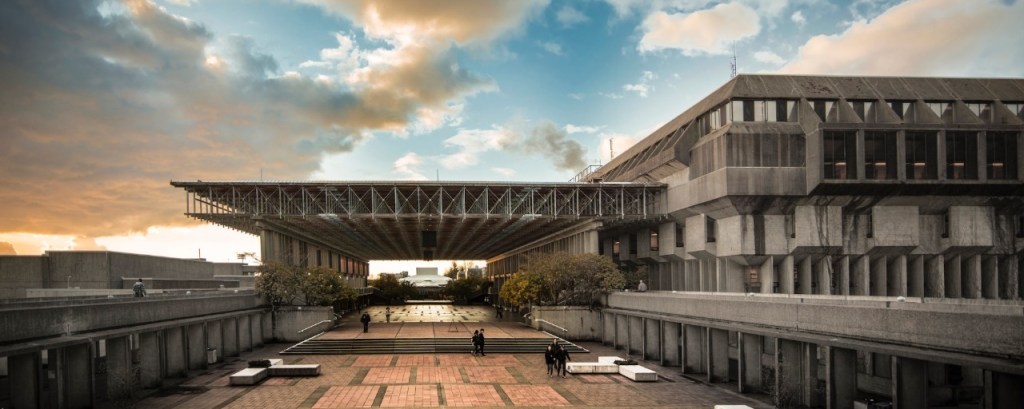
Beautiful, Brutalist Burnaby Building.
All of this is to say that Vancouver is far more interesting to me now, knowing that there are examples of this impressive architectural style dotted here and there throughout the city. If I can find more, rest assured I will share them. Thanks, London, for helping me develop a new obsession. Now just explain that Gherkin.
UPDATED: July 23, 2024
Ever have that woefully-embarrassed-although-immensely-relieved feeling you get when you’ve been looking for something specific, and you suddenly realize it’s been in front of your nose the entire time? Right. Well, I’ve been walking up and down Thurlow Street to the Burrard Skytrain station–and back–for almost a decade now, sometimes twice a day, making it…I dunno…probably well into the thousands of times that I’ve walked that route (look, I majored in English, not math).
Right there, right on the corner of Georgia and Thurlow, right in the middle of the downtown business district, right where I swing around and head for the train, is a building so overtly Brutalist–actually spelling it out for you and me, since it’s called Arthur Erickson Place–that I have been blind to it up until recently.
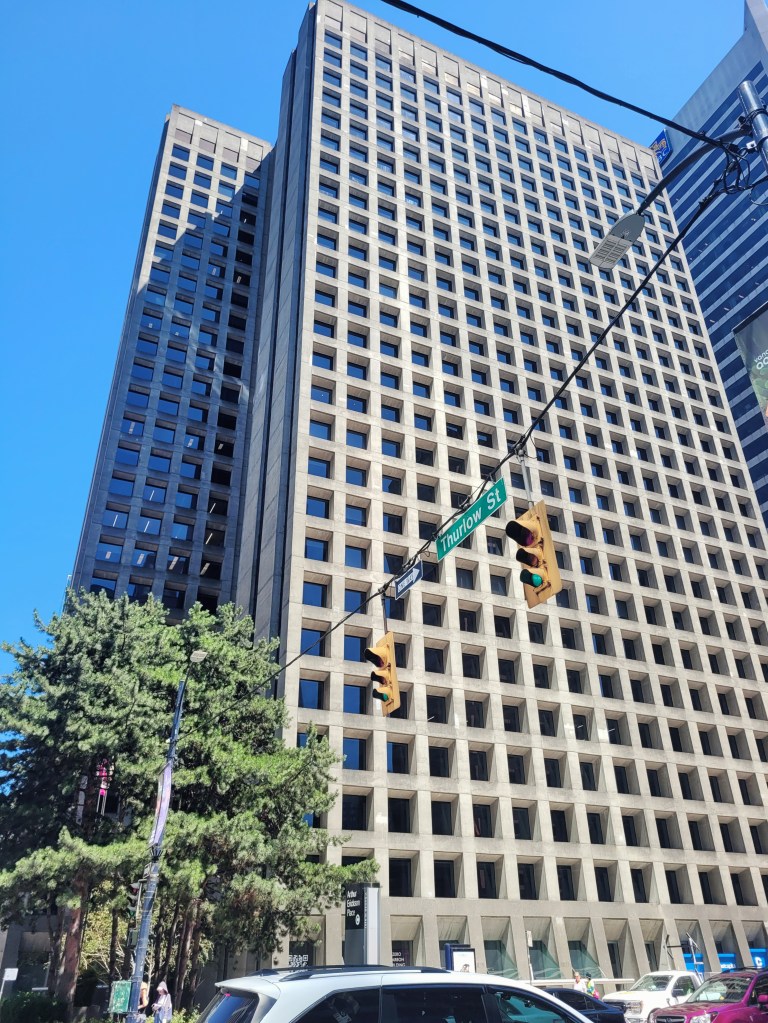
Hovering over me like a Kubrickian monolith, yet I never noticed.
Now that I’ve recognized it for what it is, it stands out to me as a stubborn Brutalist tour de force among a landscape of un-noteworthy, bland office towers throughout the downtown core. In my defense, I’ve torn up this same strip of pavement so many times, I don’t care about what’s surrounding me since the zombified smart-phone pedestrians are more than enough to handle: I just want to get on the train, or I just want to go home. It’s one or the other when I’m on Thurlow and Georgia. I’m not exactly appreciating the scenery and architecture around me.
…though I must say, it’s all I take note of now when I’m passing it by. And not just the structure, either; I very much admire the Brutalist benches in front of the building, which are a very considerate touch. Well done, Arthur E. Well done.
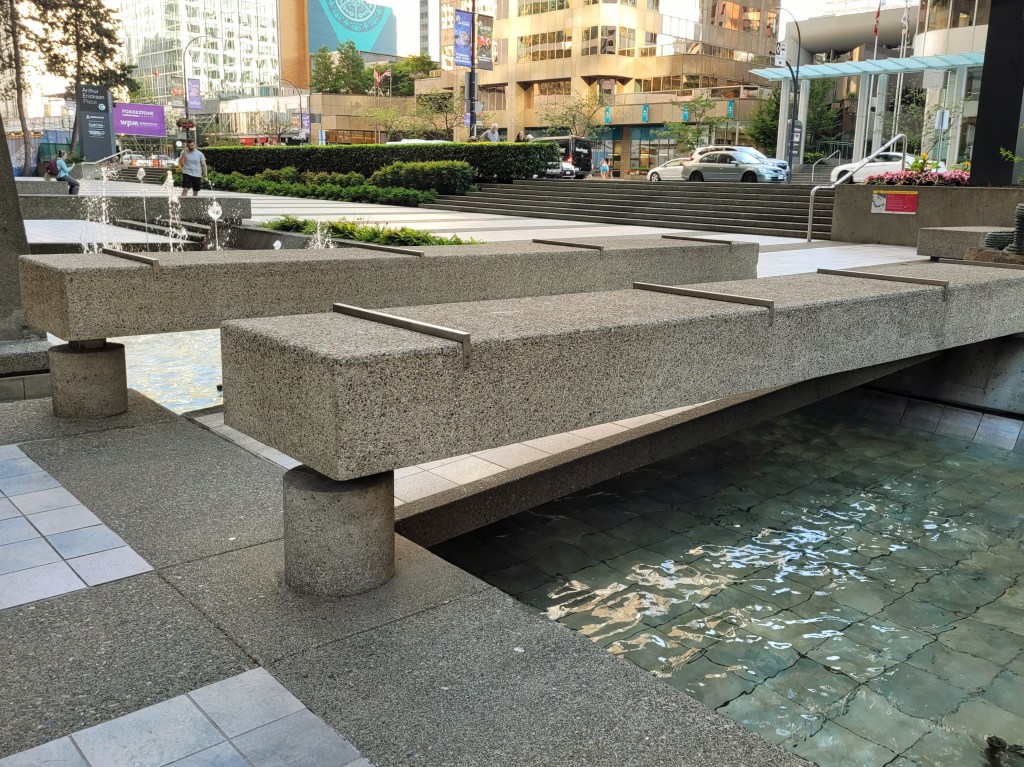
Not exactly a La-Z-Boy, but I’m sure your sandwich break will be comfortable enough on these things.


 verainvancouver@gmail.com
Leave a reply to huddlesan Cancel reply