Happy New Year!
(Obligatory Justin Trudeau grumblings ahead…I must get them out of the way)
2025 sure has gotten out of the gate with an attention-seeking ruckus. Apart from horrible plane crashes and terrifying natural disasters, the nelly little prisspot we call a Prime Minister has finally decided to step down as leader of Canada’s Liberal Party at some point. I don’t believe him. I’m not buying it. I am almost convinced that he is going to remain exactly where he is for as long as possible, extending his tenure and making excuses and changing his mind and doing it all with that characteristic smug sneer that I can’t even look at anymore. If I see his warped visage or hear his lisping, halting efforts at speech, extremely unwelcome thoughts overtake me and I have to switch it all off.
He’s been a complete failure and embarrassment, the most loathed PM in the history of this country, and has somehow skirted past innumerable scandals, misdeeds, and humiliations. However, there’s one story that appears to have been buried, and I’m shocked that it hasn’t been brought to the forefront of his myriad misfires and utter goofballness.
He’s like the turbo version of the dense rascals I’ve dated in the past who postured and pretended to be sensitive, culturally-aware, women-respecting inhabitants of Planet Earth. Is this male tendency to wear a flimsy mask of progressiveness a Gen X thing? God, maybe my generation really is hopeless. Sensitive New Age Guys (SNAGs) were exposed by the late 90s, fellas. Now, I’d like to boldly suggest Justin might have Big Dick Energy–which is a very real thing–and this is why he’s gotten away with everything that he has, but even thinking about his penis turns my cervix, fallopian tubes, ovaries, and uterus into present-day Pacific Palisades.
Speaking of being dry, it’s 2025, and many people are eschewing alcohol for the month. This is a time-honoured tradition for countless people, and I respect it entirely. If you’re a pretty steady drinker and you’re backing off for 31 days, you may be surprised at how difficult it is, at how much you’re thinking about it. During a family visit a few days ago, I was chatting with my brother-in-law about Dry January and how he doesn’t have to do it, because it’s simply not an issue he feels needs addressing. The man has a stocked bar, for pete’s sakes.
“Do you think about it?” I asked him. “The bar, I mean. All that alcohol in the house.”
He shook his head. “Not at all.” I’ve known him for almost fifteen years, and I know he’s speaking the truth.
That’s the difference between us: he can have several bottles of booze–I mean, all types of hooch–and home-brewed beer on tap in his house, and it’s just there, part of the decor that can occasionally serve as something to be used, like board games or scented candles. For someone like myself, this would never happen. I wouldn’t be able to have any of that in my house; it would be gone in record time, even if I hated it, and I legitimately hate most booze. Rum, for instance, is grotesque, but I would absolutely push myself to drink it if it were around, simply because it contains alcohol. If I were to vomit after forcing myself to gulp down such intensely awful swill (an inevitability, since the stuff is so ghastly), I would rinse my mouth and blow my nose and carry on, just because the actual alcohol is in that bottle, more than ready to do its job. And if I weren’t drinking it–if it were in my home–the very knowledge it was within reach would be in the middle of my mind somewhere, all day long, no matter what I was doing. That is how preposterous alcohol addiction is, how patently ludicrous, puzzling, and wretched.
See, I can buy a small tray of miniature chocolate muffins or sliced lemon pound cake or a bag of potato chips if any of it is on sale–I don’t really eat that stuff too often, but like a house cat, I do enjoy my treats–and I don’t think about them at all. I’ll put the pastries into the freezer and will maybe remove one at a time over the next few weeks. I will remember the potato chips only when I open the cupboard and see them, and even then, won’t even really have the urge to eat any. If I do, it’s a tiny ramekin full, and I don’t feel great after consuming them. Munchies and junk food are nothing to which I give very much thought, and over the years I’ve thrown out a lot because it’s all just been clanging around my kitchen for too long.
Many people are unable to do this, and must be very disciplined in terms of not bringing any snack food into their pantry, for it will be devoured as soon as it’s removed from the shopping bag. I think cheese might also fall into this “verboten” category for a lot of folks, based on their wailing claims to be defenseless against the siren call of a devastating aged Cheddar or paralyzing Gruyere.
That’s how I was with alcohol, and still very well might be.
I’ve written plenty on this blog about my battle with alcohol use disorder (the politely-reworded way of saying “alcoholism”), and have no shame in doing so. Why would I? I abused and became dependent on a very, very addictive drug that is legal, available absolutely everywhere, depicted as freewheeling and fun, propped up by advertising, and which is so commonplace and believed to be normal, it’s the only substance that seems to demand an explanation by perfect strangers as to why you choose not to partake in its consumption.
…but to actually become a slave to this…slave-making poison? You can count on being ridiculed, insulted, abandoned, judged, alienated, and looked upon with total disgust by the great majority of people around you. Even other alcoholics. The stooped-over, scab-infested, heavy-lidded, half-dressed, filthy, often violently-acting-out, broken souls sitting beneath various shop awnings, shoving grungy syringes into their veins or lighting up another glass bowlful of powder? They deserve compassion. Free drugs. Supervised places to use those drugs. Medical attention in which they will be given substances to ease their addiction and withdrawal. Vending machines that dispense drug-use paraphernalia. Patience and tolerance for their public outbursts and antics. A humanitarian approach; a blind eye to their medical misfortune.
The alcoholic, shaking outside the liquor store, wanting just enough change for a can of beer to stave off withdrawal symptoms, having lost everything to the drink in just a span of mere months? They’re pathetic. Beyond contempt. Weak, immoral, lazy, not even worthy of pity. A disgusting drunk. And you can even count medical personnel into this scornful perception of the pitiable alcoholic. I can tell you this from first-hand experience, which I may or may not get into here. I do know that it’s part of the book I’m writing, so either way, I’ll be writing about how getting adequate treatment for alcohol abuse is like trying to piggyback on someone else’s Netflix account indefinitely: sometimes it works out, but for the most part, you’re out of luck.
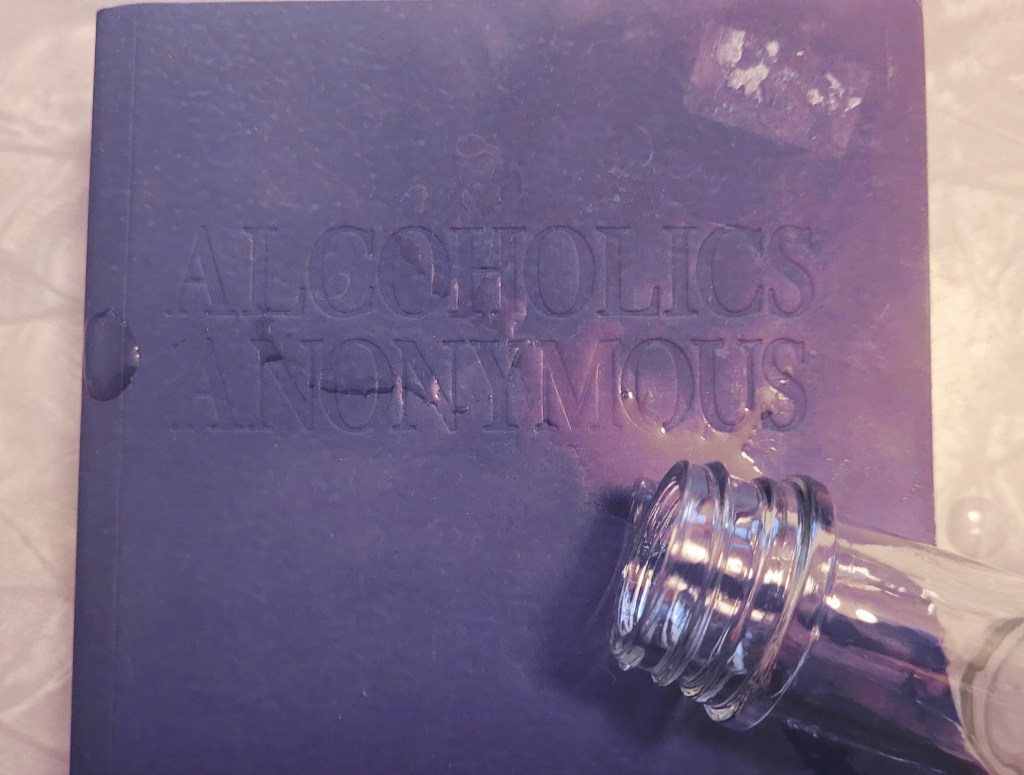
I want to talk about Alcoholics Anonymous, because for the totally uninitiated and uninformed, there is this general idea that AA is the ultimate solution or treatment for alcoholism. I am here to tell you that it is not.
Now, don’t get me wrong; I am all for whatever it takes to get sober. It is such a complex, sad, intricate ordeal to extract one’s self from the poisonous tentacles of booze addiction, and it is completely impossible to declare that there is a single solution that can be successfully applied to every individual on the planet who fights with this demon.
For some, it might actually be AA. For others, naltrexone, which is an opioid blocker that dulls the dopamine hit of ingesting one’s drug of choice. For others, it’s intensive, ongoing counselling to work through the psychological intricacies and traumas that led to a reliance on alcohol abuse. For still others, it might be harm reduction in the form of THC, which is in itself cognitively damaging and addictive, but perhaps not as destructive as ethanol.
What needs to be made clear, however, is that Alcoholics Anonymous is not treatment. I need to make this known straightaway, particularly for anyone who is dealing with a loved one caught up in the hellscape of alcohol abuse, or who is there themselves and weighing their options: AA is not treatment. It is not a form of treatment in any capacity.
It is also not a support group. Okay, perhaps I should elaborate on that a little bit: AA is not a support group unless you are strictly working the AA program. That is what the entire fellowship is about. In many ways, it is very much like a multi-level marketing scheme where The Program is the most important thing, and recruiting others into The Program is the main objective. If you aren’t working The Program, you’re going to have an extremely difficult time going to meetings, never mind thinking you can share. In AA, the only thing that works–the only approach that is acceptable, and which is given any and all credit for anyone’s sobriety–is The Program. You cannot talk about your relapse last week unless you qualify that by admitting you need The Program. You cannot discuss your struggles with staying sober unless you admit you have no power over drinking and need The Program. You are not actually successful at sobriety–you are deemed a “dry drunk,” part of the innumerable sayings and terms that get used in the meetings–unless you are strictly adhering to The Program. Forget about sitting around with others trying to get well and sharing experiences, challenges, victories, and neurological issues that might underlie your alcoholism: all roads must lead to the uncontested flawlessness that is The Program.
So what is The Program?
A very quick summary will suffice here. AA was started in the 1930s by a guy known as Bill Wilson, or Bill W, to help a small group of blue-collar men work through their unhealthy relationships with alcohol. There were really no options for alcoholics back then, or even as the decades went by. Several years ago I stayed with this rather odd man named Legs McNeil for a couple of weeks, and he told me that even by the 1970s, the main approach towards alcoholics by the medical community was to throw them into the bin. Essentially, they were considered mentally ill and admitted into psych wards, which–having gone through the crazed nightmare of alcoholism myself–isn’t actually a terrible approach. The affliction is indeed like being insane, although I’m not sure an exhausted young office worker who has become physically and psychologically reliant on Smirnoff has much in common with the family-annihilating raw-food vegan who calls himself Jesus Christ 3000.
It wasn’t until 1982 that Betty Ford made the courageous, trailblazing move forward to open a treatment centre specifically dealing with booze and pills because of her own struggles, and I will forever consider her a social and evolutionary hero for using her public platform for something so stigmatizing and polarizing.
AA has been around for nearly one hundred years, and nothing has changed. Nothing. It is exactly the same as it was when it started, because its adherents refuse to allow it to change. Never mind the giant sprints forward we’ve made in every conceivable medical, social, psychological, cultural, and political realm over the last hundred years: in AA, you either do what they’ve been doing since the 1930s, or you’re useless.
I’ve been to more AA meetings than I can count over the years, in various places, for numerous and desperate reasons, and they are all pretty much identical in form and function. This predictability, this sameness, is a comfort to the strict adherents of The Program, but there is also zero indication or records kept of any progress being made, of any accountability or statistics. It’s “anonymous,” you see, which means there is no way to understand what is happening with its members and acolytes whatsoever, particularly rates of success and long-term sobriety.
So. Let’s go to a meeting, shall we?
You walk into the gathering place (“the rooms,” as they’re called in AA), which very often means a space in a church basement. Once in a while it might be held in a community centre, but churches are the most common venue. Outside the entrance, there will invariably be some people gathered around, chatting and smoking cigarettes, meaning you’ve definitely found the place where addicts meet.

Not pictured: A bunch of alcoholics.
The room will have chairs set up in a circle, or perhaps in rows all facing front, where there will be a dreaded podium. You might see some posters or embroidered pieces on the walls saying things like One Day At A Time, or Easy Does It, or First Things First, or It Works If You Work It. There might be a table set up with a Bunn-O-Matic urn dispensing Folgers coffee, perhaps even some generously-provided cookies alongside it, and styrofoam cups. Another table is set up elsewhere with some AA literature, usually handouts or pamphlets. Still another table will be at the front of the room where the meeting’s facilitator is seated; this is where you might want to go if you have questions, or if you’re forced to come here due to a court order and need your document signed to prove attendance. There are loads of people here because they are legally obligated to be, as coming to AA is considered alcohol treatment by the courts.
If it’s your first-ever meeting at this venue, people will likely notice this, and some attendees will give you a quiet greeting, a smile, or both. Others might just give you the all-knowing “12-step eyes,” as I call it, like you’ve finally come to the right place. Depending on the meeting and its regulars, the room might be abuzz with people chatting happily with each other–or giving one another hugs–or it will be quiet as people wait for things to begin. In either case, you will not feel left out, awkward, or intimidated. People want you to be there. They’re happy you came. It’s one of the most welcoming places you could ever go when you’re at the absolute bottom of the cellar of despair and addiction, when you feel inhuman and disgraced, when everyone and everything else has abandoned you, when your guilt and shame have skyrocketed so forcefully, they have somehow penetrated the Van Allen radiation belt. In these rooms as a very scared first-timer, you’ll get bigger smiles and more warmth than you’ve felt in, perhaps, years.
This is the greatest virtue and characteristic of AA: everyone is welcome and treated with dignity and acceptance. You are not a misfit. No matter how crazy and unsalvageable you feel you might be, I guarantee you will have found the only place in the world that accepts you and shows you kindness even if you choose to slouch down in a chair, hood pulled over your head, and not say a word. Everyone present has done that; everybody in those rooms has been there. They understand more than you’d ever know.
(If, for nothing else, you need to feel this sort of humanity at your most hollowed-out and desperate, I would recommend going to a meeting no matter your issue.)
The meeting will begin at precisely the time it’s scheduled to be, and will last for exactly one hour. The facilitator will open the meeting, and ask someone to read “How It Works,” which is typically printed out on a laminated piece of paper and distributed to the volunteer. If you’re in a chair circle, you don’t have to move. If you’re at a podium meeting, you’ll have to get up and present this, as will everyone who is going to share.
…I should add that, every single time a person wants to open their mouth and say something, they must always, always preface it with “My name is ____ and I’m an alcoholic.” The group says, “Hi, ____.” Then you can carry on. I’m not exaggerating; every single time. You may have volunteered to read “How It Works,” you may be sharing some AA news when the facilitator asks if there are any announcements, you might be giving your own presentation, you may have been attending this meeting every day for the last fifteen years without a drop of booze passing by your lips. It doesn’t matter. Everyone must state their name and that they are an alcoholic before they pipe up. That is part of the ritual.
How It Works (as read out loud by a volunteer):
Rarely have we seen a person fail who has thoroughly followed our directions. Those who do not recover are people who cannot or will not completely give themselves to this simple program, usually men and women who are constitutionally incapable of being honest with themselves. They are such unfortunates. They are not at fault; they seem to have been born that way. They are naturally incapable of grasping and developing a way of life which demands rigorous honesty. Their chances are less than average. There are those, too, who suffer from grave emotional and mental disorders, but many of them do recover if they have the capacity to be honest.
Our stories disclose in a general way what we used to be like, what happened, and what we are like now. If you have decided you want what we have and are willing to go to any length to get it -then you are ready to follow directions.
At some of these you may balk. You may think you can find an easier, softer way. We doubt if you can. With all the earnestness at our command, we beg of you to be fearless and thorough from the very start. Some of us have tried to hold on to our old ideas and the result was nil until we let go absolutely.
Remember that you are dealing with alcohol – cunning, baffling, powerful! Without help it is too much for you. But there is One who has all power – That One is God. You must find Him now!
Half measures will avail you nothing. You stand at the turning point. Throw yourself under His protection and care with complete abandon.
Now we think you can take it! Here are the steps we took, which are suggested as your Program of Recovery:
- Admitted we were powerless over alcohol – that our lives had become unmanageable.
- Came to believe that a Power greater than ourselves could restore us to sanity.
- Made a decision to turn our will and our lives over to the care and direction of God as we understood Him.
- Made a searching and fearless moral inventory of ourselves.
- Admitted to God, to ourselves, and to another human being the exact nature of our wrongs.
- Were entirely willing that God remove all these defects of character.
- Humbly, on our knees, asked Him to remove our shortcomings – holding nothing back.
- Made a list of all persons we had harmed, and became willing to make complete amends to them all.
- Made direct amends to such people wherever possible, except when to do so would injure them or others.
- Continued to take personal inventory and when we were wrong promptly admitted it.
- Sought through prayer and meditation to improve our contact with God, praying only for knowledge of His will for us and the power to carry that out.
- Having had a spiritual experience as the result of this course of action, we tried to carry this message to others, especially alcoholics, and to practice these principles in all our affairs.
You may exclaim, “What an order! I can’t go through with it.” Do not be discouraged. No one among us has been able to maintain anything like perfect adherence to these principles. We are not saints. The point is, that we are willing to grow along spiritual lines. The principles we have set down are guides to progress. We claim spiritual progress rather than spiritual perfection.
As this is being read, many people will have their eyes closed to absorb the words, even if they have heard them thousands of times. This opening salve is meditative, comforting to those still in need of its familiarity and assurances.
This is where it starts to get tricky for me. It always has. No matter how many meetings I’ve gone to, no matter how many instances I have been clawing away at the gutter, I cannot get over the steps. And these steps are the core–the nerve centre, the nucleus, the kernel–of The Program.
In order to do these steps, you must find a sponsor; that is, someone in The Program who is willing to act as your mentor, guide, and alcoholic Jiminy Cricket. Sponsors are not trained counsellors, therapists, or medical professionals, but rather, other alcoholics who have gone through The Program and allegedly have some serious sober time under their belt and who can’t seem to stop attending meetings. This is the person you go to with your fears, dreads, desires, urges, worries, woes, and all things that one normally wouldn’t entrust to a complete stranger with no professional background, but that is how The Program operates. You cannot do the steps on your own, and you cannot do them with a therapist or friend. It must be another person in The Program.
And what about those steps? Let’s break them down into reality:
1. We admitted we were powerless over alcohol — that our lives had become unmanageable.
(You have absolutely no control over an inert substance. None. Forget about it.)
2. Came to believe that a Power greater than ourselves could restore us to sanity.
(So I guess you are well and truly insane. But doesn’t that mean, if you’re seeking out AA meetings, you’re not in your right mind and it may not work? You’re insane, so…isn’t thinking that a Power greater than yourself can reverse all of this an example of insane thinking?)
3. Made a decision to turn our will and our lives over to the care of God as we understood Him.
(Despite God not really showing Himself by allowing us to become powerless to alcohol, losing our lives and money and family and friends, and becoming completely insane as Step 2 underscores, I suppose we’re still just supposed to go along with God at this point.)
4. Made a searching and fearless moral inventory of ourselves.
(Go through every single thing you did wrong, upend the guilt and shame, and reinforce that you are an amoral, immoral, hateful creature.)
5. Admitted to God, to ourselves, and to another human being the exact nature of our wrongs.
(Continue to self-flagellate and wallow in the wrongdoings of your alcoholic behaviour instead of moving forward and finding a solution. Also: tell your sponsor, a total stranger, about hideous personal details that could potentially be used against you.)
6. Were entirely ready to have God remove all these defects of character.
(You’re a reprobate, a subhuman, and a defective piece of machinery, and only God can save you.)
7. Humbly asked Him to remove our shortcomings.
(Go through the God Carwash and you’ll be spiffy in no time!)
8. Made a list of all persons we had harmed, and became willing to make amends to them all.
(The best friend you wouldn’t help move across town because you were too hung over, the now-deceased parents who picked you up from the drunk tank, the spouse you cheated on recklessly, the daughter whose birthday you forgot, the bandmate whose head you used as an ashtray…despite being tortured over all of these behaviours for years, writing it down is a healing activity!)
9. Made direct amends to such people wherever possible, except when to do so would injure them or others.
(Along with the aforementioned hurt people in Step 8, do go ahead and contact former colleagues from who knows how many years ago to apologize for that time you had too many ciders and pissed in their aloe vera plant. This will all go over extremely well for everyone.)
10. Continued to take personal inventory and when we were wrong promptly admitted it.
(Reduce yourself even further to a self-loathing hunk of fecal matter.)
11. Sought through prayer and meditation to improve our conscious contact with God as we understood Him, praying only for knowledge of His will for us and the power to carry that out.
(After being entirely unforgiving with yourself due to an egregious addiction to a cheerfully-sanctioned legal drug, start praying, because you’ve basically alienated everyone else doing steps 1 – 10.)
12. Having had a spiritual awakening as the result of these Steps, we tried to carry this message to alcoholics, and to practice these principles in all our affairs.
(Pyramid scheme activated: convert and recruit!)
TO BE CONTINIUED….
And yes, it will be continued. It’s just that Taylor Swift simply doesn’t need an ounce more of attention, especially from me.


 verainvancouver@gmail.com
Leave a reply to The Nadya No-Star Show. Cancel reply