
Nothing as exciting as communist blacklisting, I’m afraid…just this guy.
If there’s one thing I enjoy more than almost anything else, it’s a good memoir, biography, or autobiography. The more salacious the better. Reading about the lives of famous and infamous people brings me an extreme amount of pleasure and always has; I think it all began with my Marilyn Monroe fixation (which I developed at a startlingly young age for reasons I still can’t understand) and, thanks to the much-appreciated sneaking-around of a classmate named Sarah who managed to secretly loan me a copy from her parents’ bedroom, I got my hands on Anthony Summers’ Goddess: The Secret Lives of Marilyn Monroe. I gorged myself silly on its contents, learning all sorts of shocking and scandalous tidbits about the extremely troubled actress; things that are now common knowledge, of course, but in the mid-80s, this was fanning-your-face scorching information, folks. Her post-autopsy photo, casually but very deliberately inserted into the second half of the picture collection, seared itself onto my brain until I couldn’t stand it anymore, and when I was in my 30s and stumbled across the book again in a second-hand store, the first thing I did was flip to the photo to make sure it was just as I remembered it.
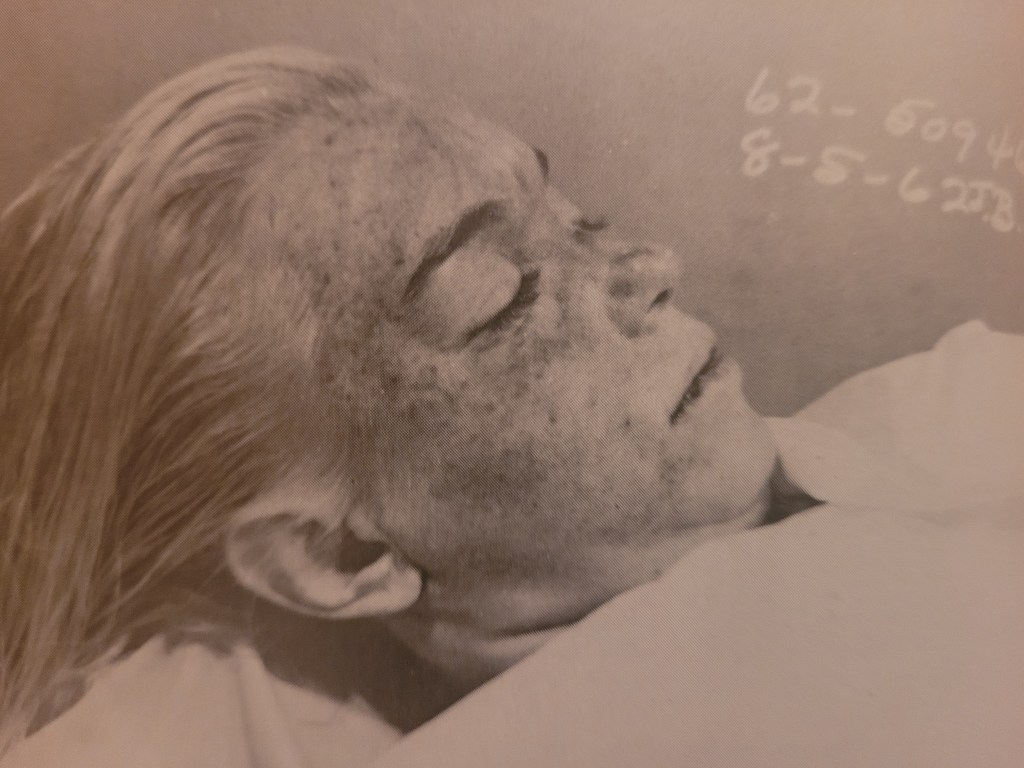
There she is, as mortal as the rest of us. Oh, should I have put a “trigger warning”? Shuffle on back to Reddit, ya spineless putz.
I also bought the book, of course.
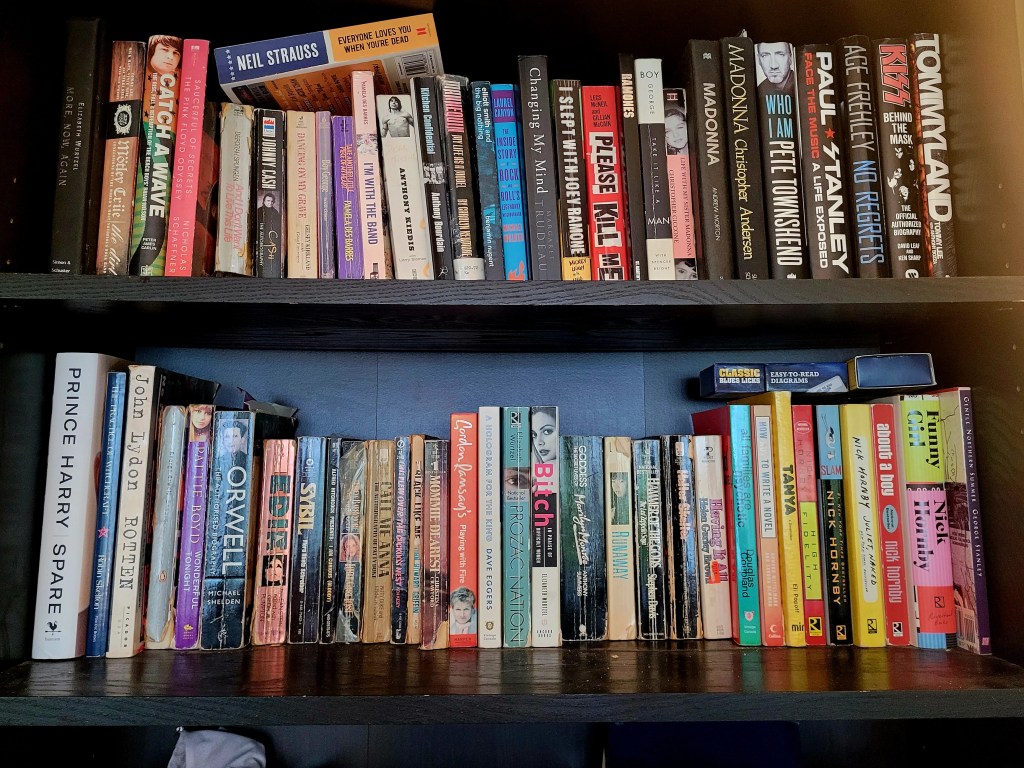
A couple of my shelves, crammed with all sorts of excellent reads. The Marilyn book is almost smack-dab in the centre of the lower one.
I think a great deal of my fascination with the lives of well-known people stems from a) wanting to be famous myself when I was a little girl, so reading about ordinary people’s journeys into fame and fortune was nothing short of aspirational, and b) making the gargantuan blunder of majoring in English, where I had no choice but to read anywhere between five and eight fiction books per week. A mandatory course called “17th Century British Novels” (all of which were as thick as a pile of concrete slabs) almost officially frightened me away from all things fiction, and since then, I’ve dealt with the fallout from having to pore through so much unwanted prose by losing myself in the real-life exploits of others.
I also watch loads of documentaries about pretty much anything; if it’s a well-made film, the topic is almost immaterial. In fact, last week I watched a very pleasant doc about Gene Wilder, and was so moved by the man and his extraordinary–although somehow normal–life, I immediately placed his 2005 memoir on hold at the library and picked it up just yesterday. I’ll crack it open tonight.
I do indeed spend quite a bit of time at the library perusing the bio and memoir sections, and like documentaries, will give nearly anything a chance. You just never know what works, and how the subject matter is treated within the pages; someone you don’t really know much about can turn out to be an individual of terrific interest, while another person who is considered a legend in their industry ends up being an indigestible hunk of unadulterated jackass. For example, a surprisingly good read was Griffin Dunne’s engaging “The Friday Afternoon Club,” while a disappointing effort was “Betsey: A Memoir,” a terribly-written, shallow, yawn-worthy look at the influential fashion designer Betsey Johnson. Sometimes I never know, but I’ll give it a shot.
…which is where “Brat: An 80s Story” by Andrew McCarthy enters the picture.
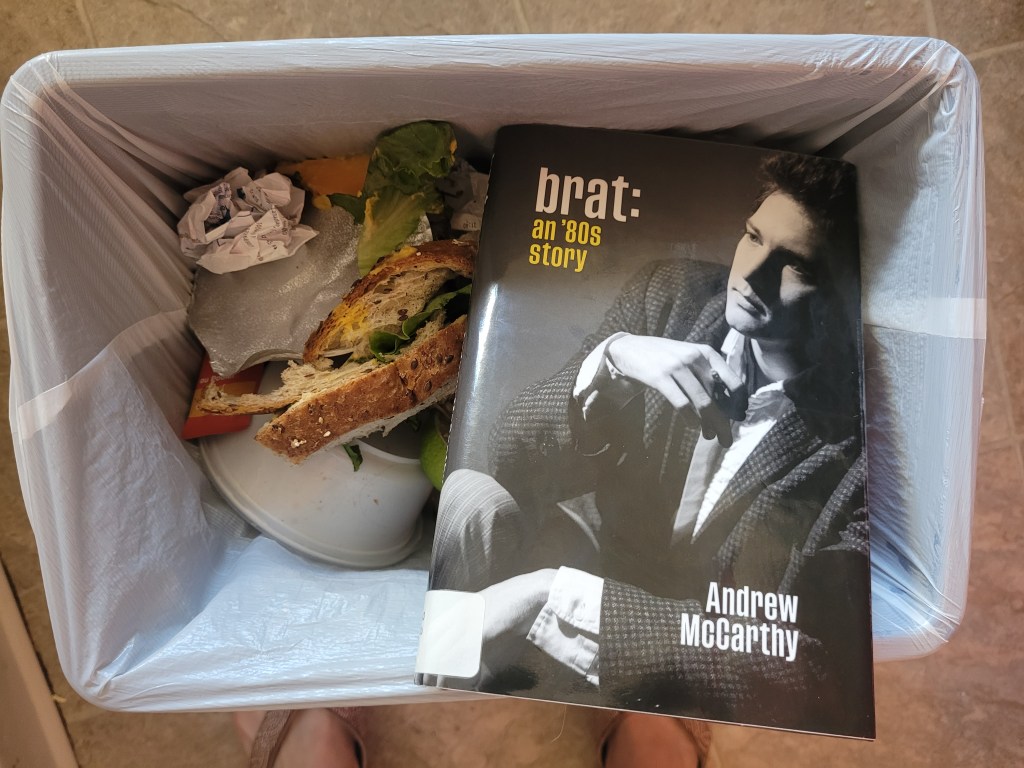
And this is how it exited the picture.
Andrew, Andrew, oh Andrew McCarthy. I’m not sure where to start with this book of yours. There aren’t too many celebrity memoirs (are you, in fact, still considered a celebrity?) which leave such an impact on me that I have to plunge ahead and share my opinions about them, but you, my dear boy, are the exception. I’m not sure how you’ll take that last sentence, but take it you must, because I spent the last two days wondering how to approach this particular essay and I still don’t know if I’ll be successful in my attempts to articulate my thoughts and impressions of this 2021 exercise in almost comical self-seriousness and unwanted rumination.
Readers, do you know who Andrew McCarthy is? I suppose it depends on your generation, your interest in popular culture, and whether you managed to somehow bypass the pulsating, pastel, synthesizer-accompanied decade that was the 1980s. During that era–of which I have very fond memories, as it was probably the best time to be a kid–the media coined a term called “The Brat Pack” to describe a group of youngish actors who were making their appearance in a few zeitgeisty movies aimed at teenagers, mostly. The name was a riff on the Rat Pack, who were a group of hep, finger-snapping daddy-o’s back in the very early 60s who did something or another together; I don’t think I know what, exactly, and I can’t say I care. Dean Martin, Jerry Lewis, Frank Sinatra? Why, I ask you, would any of those now-deceased men make any difference to my life, and why would I give a single one of them even half of a passing thought? The only one of those ring-a-ding-dingalings who might have sparked a small nod of acknowledgement is Sammy Davis Jr., and that’s only because the guy could tap-dance, and we all know that I was quite the hoofer back in my day.
…but then I read Linda Lovelace’s memoir several years ago and learned the nauseating information that Sammy was so mesmerized by her technique in the vintage porno film “Deep Throat,” he became a relentless sex pest and kept turning up at her house, insisting that she demonstrate her prowess on him again and again without even returning the favour. Therefore, any shuffle-ball-change dance respect this one-eyed creep may have held in my mind has been rendered nonexistent, and I’m okay with that.
As far as I understand it, these kids (I’m old enough to call them kids now) in the Brat Pack weren’t actually a tight-knit group of friends, they were simply the result of media branding. It all began with the objectively awful film “St. Elmo’s Fire,” and everything you need to know about it can be perfectly, hilariously summed up in these flawless ten minutes. Oh, it also had one of my not-guilty-whatsoever pleasure songs which was less about a bunch of good-looking yo-yos entering Real Adulthood, and more about Rick Hansen, a Canadian hero who wheelchaired around the planet at the time of this film’s release–a song that is, sincerely, about the indomitable spirit of human beings.
All of this brings me back to Andrew McCarthy. Andrew was apparently a member of this faux-gang of Hollywood rabble-rousers, hence the title of his book. There’s only one issue. Let’s see if you can spot it from the following list:
Demi Moore
Emilio Estevez
Rob Lowe
Anthony Michael Hall
Molly Ringwald
Judd Nelson
Ally Sheedy
Andrew McCarthy
I tried to put it into descending order as best as I was able to. The problem, clearly, is the fact that Andrew has not just descended on that list in order of cultural relevance and career success, but he has descended into actual real-life obscurity. I would add Judd Nelson and Ally Sheedy to that stark state of professional reality, but the difference is, those two haven’t chosen to write a solemn memoir about their flash with fleeting fame forty years ago.
…and I wouldn’t care so much about that if the book itself had any sense of self-awareness, or irony, or humour, or good-naturedness. Loads of people who were one-hit wonders either in film, TV, or music have written memoirs about their experiences, and most of them seem to understand exactly what their place was during a specific cultural epoch. A great example of this is the satisfying, entertaining “So You Wanna Be a Rock & Roll Star: How I Machine-Gunned a Roomful of Record Executives and Other True Tales from a Drummer’s Life” by Jacob Slichter, the skin-basher in the band Semisonic, famous in the 90s for exactly one hit song. He is under no illusions about the fact that his band is done and dusted and had the great, rare fortune to hit paydirt with one single, yet he also provides intriguing insight into the machinations of exactly what it meant to belong to a record label in the 90s; I’m sure the reality of being signed to a major-label nowadays would be a jarring, horrifying read, although I’m waiting for one of the current industry plants / manufactured pop stars to just say “sod this” and tell all of us exactly what’s going on over there.
Enough preamble. Let’s get to Andrew’s memoir.
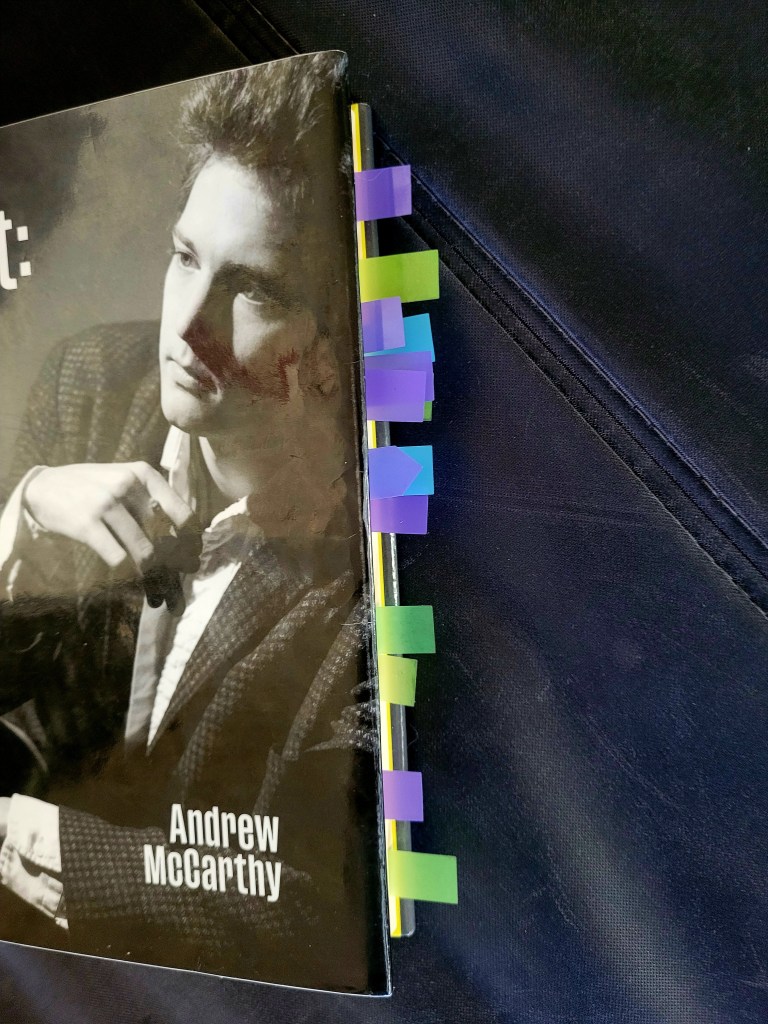
When Nadya is meticulously tabbing certain portions of a book, you know it’s a book she isn’t going to back down from. She also refers to herself in the third person when she’s been too crazily invested in it.
I will give him this: he knows what people want to hear about. They want to hear about the very thing that catapulted him into temporary fame, which is the so-eighties-it-hurts John Hughes teen movie “Pretty in Pink.” This is the one where Molly Ringwald, a stylish clotheshorse from the wrong side of the tracks, ends up with Andrew McCarthy’s character Blane (“Blane?! That’s not a name, that’s a major appliance!” is one of the best lines from the film) and repurposes an old dress into the ugliest outfit ever worn to anybody’s senior prom either in real life or make-believe. Ever. Ever. Just the ugliest fucking thing ever, by 80s standards, by 90s standards, even by current-day No Standards.
Andrew knows that PiP is what made him officially famous, so his prologue is all about the Hollywood premiere of the film in 1986 at Mann’s Chinese Theatre, the place where old movie stars have their hand and feet prints embedded in concrete for all time (I’ve been there; it’s no big whoop). He talks about how, once the lights went down and the movie began, he ducked out of the theatre and went across the street to the bar, where he “downed more than a few straight vodkas on the rocks” and didn’t make eye contact with anyone. A paragraph or so later, he mentions that he and James Spader (also in the film) are being interviewed by Fee Waybill of the Tubes, who had
…the unenviable task of trying to get…me to speak coherently about the movie–or anything at all. I swayed back and forth, drunk and anxious, blowing cigarette smoke and trying not to appear frozen by the few benign questions that were lobbed my way. In a career of bad interviews, this one was particularly inept.
Interesting, I thought. Maybe this is going to be a book about how he annihilated his own promising career through crippling mental-health issues, devastating self-esteem challenges, and an increasing dependency on alcohol. I could certainly relate. In fact, millions upon millions of struggling people could relate to such matters. Was this the book that Andrew decided to write? A cautionary tale weaving into a spiritual catharsis? You can’t damn a fella for doing such a thing; in fact, you’d have to admire him.
But then:
Over the next several years I would ride high and get tumbled and tossed in the backwash. What would happen over that brief time would grow to define me in the eyes of a great many–as well as in my own estimation–for a long, long time to come.
Huh?
(And that’s just the end of the brief prologue.)
Wait a minute, Andrew McCarthy. Are you trying to say that you soared to indescribable heights of global fame and dazzling fortune, rivaling the brightest and most influential of Hollywood stars, leaving an indelible imprint on the causeway of celebrity, stardom, and cultural impact? Because that’s what I just got from those two sentences. I’ve been called many things, but “dense” is not one of them.
This is where I knew I was in for a heck of a shattering read. There’s no other way to put this: Andrew McCarthy, artiste extraordinaire, absolutely believes his farts smell of peonies, newborn lambs, and Jesus. However, I’ll also give him this: compared to his peers, he has aged very well. The man is extremely good-looking for someone who is about to turn 63. Yes, good-looking men and women are forgiven for countless sins and infractions, it is true. But I’m not sure if this book can be so easily waved aside with a sleazy wink and a thumbs-up.
* * * * *
Andrew takes us on an achingly dull meander through his upbringing and childhood, most of which I barely skimmed, because there’s no other way to put this: I don’t care. Andrew McCarthy is nobody to me. And he doesn’t even have to be somebody to me, but it’s his doggone certainty that he is of absolute importance in the grand sphere of the entertainment industry–devoid of a single lick of wit, self-awareness, or even relaxed self-deprecation–that made this memoir a jaw-dropping read for all the wrong reasons.
Let’s skip past his inability to play basketball or whatever it was, thanks to being too short and skinny, to the part where he decides he’s going to ACT. He auditions for his high school’s production of Oliver!, where he attempted a Cockney accent and used his bleating tenor from glee club in order to secure the part of the Artful Dodger. Great! He got a part in his high school’s musical! Andrew, however, sees this cute little event as such:
It is, of course, easier to untangle events and see their significance in hindsight, but I knew enough to realize that whatever had happened to me on that stage was important. Yet, I told no one the magnitude of my new feelings. If, as Tennessee Williams had written, a light had been turned on, then mine was a single candle’s flame, one I knew might be easily extinguished.
WHOA WHOA WHOA LET’S HOLD OUR HORSES HERE you got a role in your high school musical. You played the Artful Dodger in a New Jersey high school production of a show in which you more than likely employed an excruciating accent and probably spoke-sang the entire performance of “Consider Yourself,” your big number, yet you’re writing impassioned treatises about the enormity of this world-jostling event as though you were experiencing a rapturous artistic chrysalis. And maybe you were, but fuck almighty, keep it to yourself, y’know? It’s embarrassing (but by no means the only embarrassing morsel in this book). And furthermore, do you know who also played the Artful Dodger, except in London and Broadway productions of Oliver! and was nominated for a Tony award? Davy Jones. That’s right, Davy Jones, of whom I am very tired, but I can’t deny his star power or legend status. I don’t need to explain who he is. So until you’ve gone and flawlessly pulled off a great big gay dance onscreen the way Davy did, I think you should tuck that Artful Dodger awakening into your high school yearbook and rein it in a bit.
The taste of the stage stuck with our shrimpy Andy, and he told his parents he wanted to study acting in college. You can imagine how well that went, but since his grades were apparently subterranean, there wasn’t much else for him to focus on; in fact, he barely graduated. He made a deal with his drama teacher, Mr. Gorelick, that he’d maintain a B average if the teacher could get him into drama school, and I guess he was successful, because on graduation day,
Mr. Cunningham, the headmaster, held out my diploma. As I neared, he extended his hand to me and leaned down close to my ear. He whispered, “Go get ‘em, Dodger.”

OY.
We are then taken through the very uninteresting journey of Andrew as he relocates across the river to New York City and studies Method acting, because of course he does, furrowing his brow and perspiring with excruciating focus as though he were being mentored at Jedi school. And, in some ways, I think he actually believes that he was:
The degree to which I was unable to control my energy while performing equaled the degree to which I was learning to hide my true reactions when I wasn’t. By the time Terry [his acting teacher] tilted her head to the side, squinted at me, and suggested that I might yet be “too young to do the work,” I was already nodding in that nonchalant way, displaying indifference and disregard, masking the disappointment and hurt that I had already accepted as normal in all school circumstances. But then Terry surprised me by adding, “But I think you might want to stick around.”
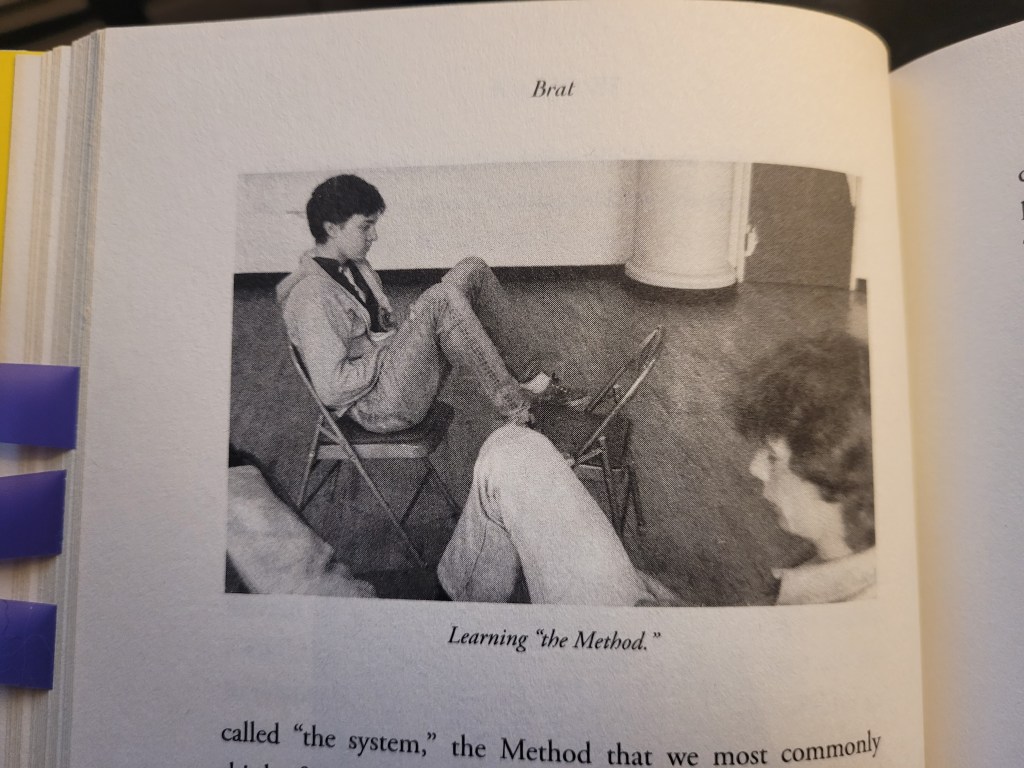
Marlon Brando, Marilyn Monroe, Jane Fonda, James Dean, and…uh, Andrew McCarthy all honed their acting chops using this technique.
I guess he had wrung all he possibly could out of his adolescent Oliver! performance, because he appears to play the same card no matter where he is; and when he is asked for spontaneity and demonstration, it’s absolutely the only one he’s got in his hand. I wish I were exaggerating:
On the first day our class met, we began with what Terry called a “sound exercise,” in which the actor stands in front of the class and sings the first song that pops into his or her head…one syllable at a time…it can be a raw, unnerving experience, one that exposes a lot about the participant and his or her vulnerabilities and defenses. The first song that popped into my head was, unsurprisingly, “Consider Yourself” from my Oliver! days.
Oh, give us a big fat break already, Andrew McCarthy. And his “Oliver! days”? You’d think he had a years-long run on the Great White Way and was drawing upon those grueling nightly performances (plus matinees on weekends!) for guidance and interpretation, but he seems to overlook the fact that he was merely a scrawny pubescent from Jersey who once performed for a bunch of cigarette-puffing parents in the 70s. There’s absolutely nothing wrong with that, but why can’t Andrew just say something like–oh, I don’t know–”I was out of my element, having only been in a high school musical, really” or “I was frozen, intimidated, and the only thing that came to mind was the Artful Dodger since it was the only real role I played, and that was in high school”? Why no humility? Why no self-reflecting sigh of amusement in regards to his lack of experience?
We get more studying of acting, more details that don’t hold my interest, until we unexpectedly get to what we can all agree is the really good part: Andrew is still very young–late teens or perhaps twenty–and throws a Hallowe’en party where he technically loses his virginity. I love a good virginity-loss story unless it’s traumatic, which it can be for many people, but if it’s just typical fumbling-around with genitals and a classic Is That All There Is? aftermath, I do enjoy hearing about it…because that’s exactly how mine played out.
(He also doesn’t mention whether he dressed up as the blasted Artful Dodger for this particular soiree, but the odds on that are very, very high)
In Andy’s specific rite of passage, a young woman took an interest in him during the party, and after everyone left and they were alone sipping their beers, she led him to his own bed and “thankfully, she seemed to know what to do. Soon she was straddling me.” Ah, a seasoned, unabashed young lady who can guide him in the ways of sensuality and tender lovemaking: every lad’s dream! Here we go!
As things began to find their way, she abruptly stopped moving and, looking down at me, asked, “Are you Asian?”
It seemed an odd question at that moment.
“Um, no,” I said.
“Are you sure?” she asked.
“I don’t think so,” I answered.
She went back to business but kept looking down at my chest in a strange way. I was beginning to get more uncomfortable than I already had been–which is saying a lot.
Then she stopped again.
“Are you sure you’re not Japanese or something?”
“Why do you keep asking me that?” I blurted out. “Is there something wrong with my dick?”
“Your cock is nice but you don’t have very much body hair, and Asians don’t have much body hair, so I thought maybe you were Japanese or Chinese.”
Okay.
Who’s gonna tell him?
I guess I’m gonna have to be the one to tell him.
Andrew, to this crass young lady, your cock was not “nice.” It was not nice, okay? To her–not your current wife, not your past partners–it did not measure up, so to speak.
I can assure you she did not think you were Chinese or Japanese.
I’m not defending her; in fact, I think her conduct was completely tacky, judgmental, and coarse. She asked if you were Asian because she thought your penis was small, and we all know the alleged stereotype about Asians and their comparatively subpar penis sizes; after all, that’s why you asked her if she was referring to your junk. Asians are supposed to have pencil dicks. We all think it. We all somehow know it. Heck, I got to third base with some DJ in South Korea a hundred years ago, and I wasn’t shocked by his diminutive todger size (length and girth, if you must know), because I was expecting it. Apparently it’s been circulated as a down-low fact for decades, if this account of your sexual escapade is steeped in truth. But her words certainly weren’t; she was being a downright offensive strumpet by staring at you and shaming you. I’d say she can quite sincerely go get bent since she didn’t deserve your dick, and I’m going to tell you something very real, so listen up: dick is a hill that many, many of us will die on.
…and then this happened:
“Do you want to use some Vaseline?” [I asked]
I’d heard somewhere that Vaseline, which I had beside my bed for my dry hands, was a good sex aid and I wanted to show her that I knew what I was doing.
“Sure,” she replied.
We kept at it for a bit longer, and then the whole thing just sort of stopped before either of us really got anywhere and she was up and gone. Never to be seen or heard from again. For some time after, this unfulfilled act was the highlight of my sex life.
God. God! Vaseline for vaginal intercourse! I know the word “cringe” is used in a stupid, erroneous way nowadays, but that’s what I’m actually doing as I type this out; and not because it’s giving me second-hand embarrassment, but because it’s giving me second-hand candida albicans. My quadriceps tensed and my Kegel muscles retreated into my spleen when I thought about poor hapless Andrew getting a good pawful of petroleum jelly–the stuff he kept beside his bed for his dry hands, of course–and slathering it onto his (perfectly decent, I’m sure) wang, then plunging that thing straight into a woman’s vagina, ostensibly sliding it in and out.
Vaseline is about the worst thing you could use for sex. It is not water-soluble. It is greasy, lumpy gel that cannot dissolve or be broken down in the warm folds of a self-cleaning vagina, meaning that, along with the bacteria that is compounded during the act of sex, the end result is a hellish variety pack of all sorts of irritations and infections. Thick discharges, itchiness, redness, bacterial vaginosis…all of this and more will happen if you use an oil-based lubricant during sex, especially the petroleum glop that is Vaseline. I had a similar, visceral (vaginal?) reaction when I had no choice but to hear about Sean “Diddy” Combs and his insistence on his female partners using baby oil for those sordid “freak-offs” he kept hosting…and that stuff has the added bonus of artificial baby-powder scent, meaning it’s double the fun downstairs when it comes to needing cold compresses, antibiotics, antifungal creams, probiotic suppositories, and bucketfuls of yogurt.
Perhaps Li’l Miss Experienced walked away with some discomfort, which may or may not have served her right for making you feel horrible about your body, Andrew McCarthy. You picked the wrong person to lose it to. Then again, that’s par for the course: I can’t imagine anyone actually picking the right person to lose their virginity to. That would be going against the humiliating laws of nature.
* * * * *
Andrew carries on, eventually nabbing a role in some early-80s flick called “Class” that I’ve never seen. Jacqueline Bisset had a role in the film, and she was supposedly considered a real dish in her day. Her partner at the time was the dancer / actor Alexander Gudinov, a steely Russian with a predictable penchant for quaffing vodka by the barrelful (alcohol eventually ended up killing him). Andrew, the baby-faced young thing who was new to Los Angeles, had nowhere to stay, and wouldn’t you know it?
“Well, then why don’t you stay with me?” Jackie asked.
“Um.”
“You don’t know anyone in L.A. It can be a lonely place. It’ll be a pleasure to host you.”
That’s right, a sexy actress whose boyfriend suffered from crippling alcohol-use disorder, smoked like a campfire, and made his own vodka, just wanted to show some benevolence and kindness to the Bambi-eyed, cute, homeless young actor. That’s it. Roommates. Nothing to see here. That newly-purchased, recently-researched tube of Astroglide beside Andrew’s bed? That’s for his dry feet.
In regards to the evil swill, Andrew alludes to developing a taste for it during the filming of “St. Elmo’s Fire” a year or two after boinking his benefactor platonically sharing a living space with Jackie Bisset. This is also where things get interesting for me, as we know I’ve shared my experiences with battling the bottle, and I have boundless empathy, compassion, and understanding for those of us who succumb to its deleterious effects:
As a welcoming gift to mark the start of filming, the producers had given me a bottle of red wine. For a long while it remained unopened. I had never even drunk wine, but it seems telling to me now that I took the bottle home with me from my hotel to my new home. One evening soon after my arrival in my new apartment, feeling adrift and looking to fulfill some romantic notion I had about living a tragic artist’s existence [now we’re getting closer to his psyche], I sat in the window seat, threw open the sash, popped the cork, and took a sip. I didn’t care for the astringent taste, but I finished the glass. Then I poured another. Until the bottle was empty. It marked the first time I would drink alone.
I find it remarkable that Andrew could essentially pinpoint the very occasion in which his dependency on alcohol was born. I also find it remarkable that it wasn’t due to mitigating a plague of staggering insecurity, or to quell pangs of buried childhood trauma, or even to unlock some confidence beneath an exhausting sheen of agonizing shyness and social anxiety. No, it appears that Andrew began drinking because he thought it would add to his ridiculous, youth-fueled notions of being some kind of struggling actor, an unrealized artist; it’s what creative people do.
Far be it from me to condemn or call him a fool for such a thought process; it’s probably the most vulnerable, self-aware, and authentic with himself (and us) that he gets in the entire book. None of us know why we start drinking, we just do. We drink for reasons that are individual, independent, private, and both complex and simple. We use an addictive drug to take care of this or that, until it’s far too late and we suddenly realize that, uh-oh, we have become addicted to that addictive drug.
That’s how it works. That’s how it all begins. And as I’ve always said, it can happen to any of us. Any ding-dong one of us.
My God, but I’m getting tired of writing about this book; it’s been almost four hours of clacking away on my laptop. I had a lot more to say about it, and I may go back and update this to add in the things I’m omitting, but for now I have severe eyestrain and I haven’t even begun editing. I will conclude this by saying I endured quite a bit from Andrew McCarthy in this unnecessary memoir, but I took it like a champ because that’s what I am. I did flip the pages forward to see if he had anything to say about Kim Cattrall, his co-star in the silly “Mannequin” and the absolute star of HBO’s smash series “Sex and the City” (which I, and zillions of other generation-spanning women, genuinely adore), but nothing. Not a word!
So I went back to the section about “Pretty in Pink,” which was the zenith of his movie career and whose professional environment appeared to be somewhat sullied by the cretinous, off-putting personality of Andrew. He didn’t come right out and say “I was an asshole,” but instead, employed the time-honoured writerly technique of Show, Don’t Tell…except I’m not sure that, to this day, he understands that he was behaving like a roaring twat. In relation to his PiP costar, Jon Cryer:
Jon and I had not gotten along during filming. Jon had a nervous laugh I found irritating, and my impatience with him exacerbated any feelings of insecurity he might have been experiencing, which only fed my irritation, which in turn fueled his feelings of insecurity, and around and around it went.
In relation to his teenage PiP costar, Molly Ringwald, who basically got him the part:
Molly and I never grew close. I found her fiercely intelligent and determined. She was the epicenter of the Hughes world; no one knew it better or worked harder to maintain its integrity. Within a cast of equals, Molly was more equal, and her opinions carried added heft. So in a move that was more unconscious than deliberate, I concluded that to forge my own unique imprint–I felt my success rested on not being easily dismissed as some kind of interchangeable Hughes teen–my power on the set would come from maintaining some form of distance.
Well, smell you, Andrew McCarthy.
However, I hit my absolute limit when I read the following about his role as an earnest teenager who, accompanied by a new-wave soundtrack, shuns American caste systems when he chooses to date Molly Ringwald’s poorer character. After everything I had endured in this book so far–all of the mirror-staring, the convictions that he was a high-caliber artist, the unwarranted ego, the overall lack of honesty with himself–it was the following passage that was the final nail in the casket:
In this movie, as in “St. Elmo’s Fire,” I radiated a freshness, a sense of discovery, that can be captured only in passing. It’s a moment of youth that transcends talent or acting ability. It is a quality, not a skill. I boast no comparison when I say it’s a quality that James Dean displayed in “East of Eden”; Emily Watson had it in “Breaking the Waves”; and it was undeniable in Leonardo DiCaprio in “What’s Eating Gilbert Grape.” There are countless other examples. Like the first light of dawn, there is a transitory magic in it, a singular quality, something so fresh it seems it must be occurring for the first time. It’s something we as an audience get to piggyback on and relive or discover in ourselves vicariously. Over this, a deep bond between actor and audience can be created.
And that, as they say, was that for me.
Andrew McCarthy, I conclude my review of your book with one simple, profound, and concise sentiment.
Love
Nadya.


 verainvancouver@gmail.com
Leave a reply to Anonymous Cancel reply